

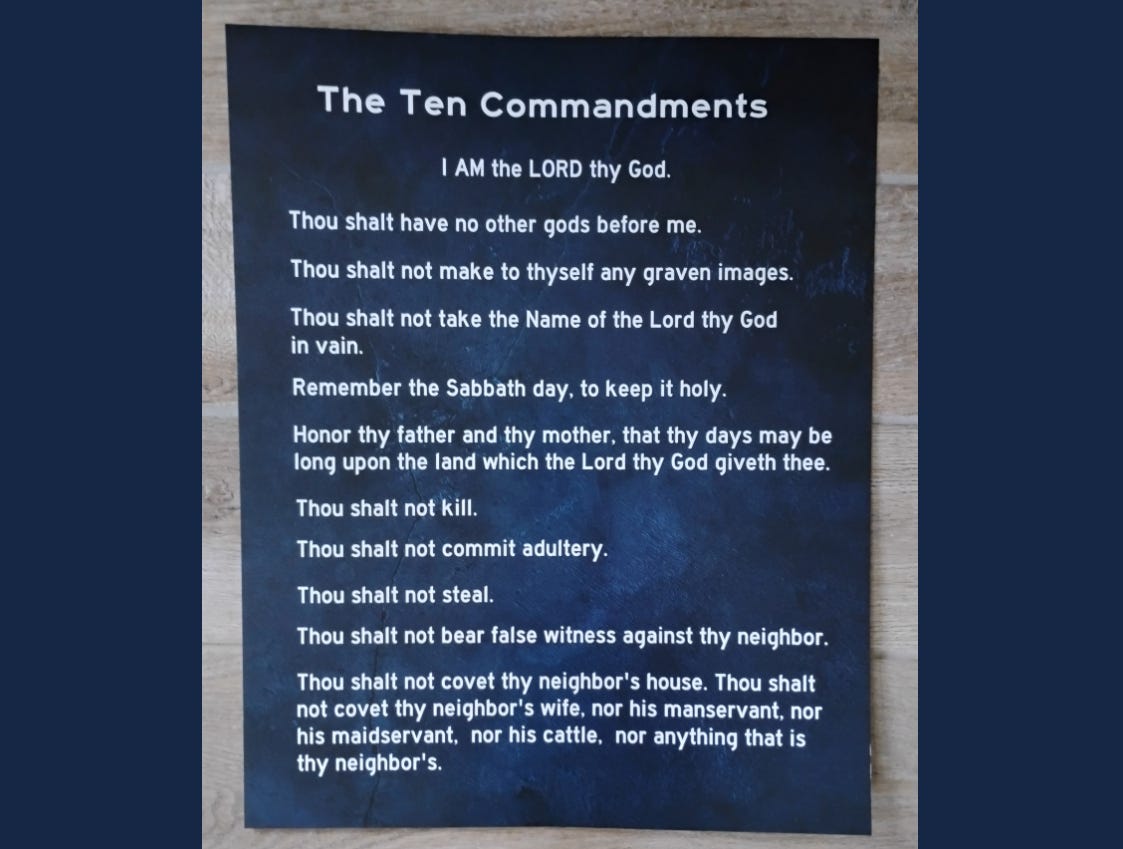
Lawyers representing a theologically diverse set of parents and their children went to the Supreme Court earlier this week in their effort to strike down a law passed by Texas lawmakers in 2025 that requires a conspicuous copy of an abridged version of the Ten Commandments to be posted in public-school classrooms.
Their appeal of a U.S. Court of Appeals for the Fifth Circuit ruling says that the law violates the establishment clause of the First Amendment because it imposes religious messages on a captive audience, and that it violates the free-exercise clause because it poses a “very real threat” of undermining the religious beliefs and practices that parents wish to instill in their children.
The cases are Nathan v. Alamo Heights Independent School District and Ringer v. Comal Independent School District. The petitioners in the two cases are all parents and their children from more than two dozen families who have sued a similar number of Texas school districts. The parents are affiliated with religions that include Baha’ism, Christianity, Hinduism, Judaism, Unitarian Universalism and nonreligious traditions. At least two rabbis and a parent using the title of “Rev.” are among the petitioners.
Lawyers representing the families are receiving support from the American Civil Liberties Union, Americans United for Separation of Church and State, and the Freedom from Religion Foundation.
In their petition to the Supreme Court, the lawyers point out the court has faced this issue before — its 1980 ruling in Stone v. Graham invalidated a Kentucky similar similar to Texas’s:
The Court should grant the petition because the court of appeals, in upholding S.B. 10, flouted this Court’s binding precedents and gutted the religious freedom rights of public-school children and parents.
The lawyers also argued that the appeals court’s ruling destabilizes the laws on free exercise of religion:
If the permanent, unavoidable imposition of biblical scripture in public-school classrooms does not interfere with, or threaten to undermine, parents’ ability to direct their children’s religious education and to instill particular religious beliefs and practices, it is difficult to imagine what would. [Emphasis in original.]
If the Supreme Court agrees to hear the case, oral arguments would probably be heard during the term that begins in October or the term that begins in October 2027. The court faces no deadline in deciding whether to accept the case, although it probably will do so in the next few months. At least four of the nine justices must agree to take the case before a hearing can be held.
If the court decides not to hear the case, the appeals court’s ruling would remain in effect in areas included in its jurisdiction, so that the Ten Commandments would be posted in some Texas schools. But court decisions striking similar laws in Louisiana and Arkansas would also remain in effect. The current situation, then, is that constitutional law is being applied differently in different states, giving a motivation for the Supreme Court to hear the case.
Earlier version (April 21, 2026): Appeals court agrees with Texas that Ten Commandments law is constitutional
Without a vote to spare, a federal appeals court has determined that a 2025 Texas law requiring the display of the Ten Commandments in public school classrooms is constitutional.
By a 9-8 vote today, the U.S. Court of Appeals for the Fifth Circuit found that the law does not violate the clause of the First Amendment prohibiting the establishment of religion. It also found that the law does not interfere with the rights of parents to direct the religious upbringing of their children.
The court’s majority opinion, written by Judge Stuart Kyle Duncan, who was appointed to the court in 2017 by President Donald Trump, said of the Texas law, known as Senate Bill 10:
S.B. 10 looks nothing like a historical religious establishment. It does not tell churches or synagogues or mosques what to believe or how to worship or whom to employ as priests, rabbis, or imams. It punishes no one who rejects the Ten Commandments, no matter the reason. It levies no taxes to support any clergy. It does not co-opt churches to perform civic functions. These are the kinds of things “establishments of religion” did at the founding. S.B. 10 does none of them.
Last year, Texas became the third state to require the posting of the Ten Commandments in public classrooms, following Louisiana and Arkansas. Federal courts have found the Louisiana and Arkansas laws unconstitutional, and the Texas law was found unconstitutional in two federal rulings before today’s decision.
According to news reports, attorneys for the parents who had filed the lawsuit against Texas said they plan to appeal today’s ruling immediately. Because the ruling conflicts with those in Louisiana and Arkansas, it is likely that the Supreme Court will agree to hear the case in older to resolve the conflicting opinions.
If the Supreme Court agrees to hear the case, it won’t be the first time that the top court has considered the issue. The court ruled 5-4 in 1980 in Stone v. Graham that a similar Kentucky law was unconstitutional. During the past decade, however, the high court has demonstrated a willingness to expand the circumstances under which religion can be a presence in public schools.
Earlier version (Nov. 20, 2025): Ten Commandments law in Texas found unconstitutional by another judge
Some school districts in Texas are complying with a new law that requires them to post a copy of the Ten Commandments in public-school classrooms. But wherever the law has been challenged, courts have struck it down, saying it conflicts with First Amendment guarantees of freedom of religion and freedom from the government establishment of religion.
The most recent such decision came this week in a ruling by Judge Orlando L. Garcia of U.S. District Court for the Western District of Texas. The ruling applies to 14 school districts, including some of the state’s largest such as those in Fort Worth and Arlington.
Earlier this year, Judge Fred Biery of the same court issued a similar ruling that applied to 11 school districts. Similar laws in Louisiana and Arkansas have also been invalidated by federal courts.
Texas, Louisiana and Arkansas are the three states that have passed Ten Commandments school legislation in recent years. Although the laws have been challenged in all three states, no court yet has upheld one.
Among other things, Garcia said in his ruling that Texas law violates the First Amendment because “it is impracticable, if not impossible, to prevent plaintiffs from being subjected to unwelcome religious displays” when the Ten Commandments are conspicuously posted in the way the law requires.
The Texas law, which had overwhelming Republican support and Democratic opposition, was signed by Gov. Greg Abbott in June.
Texas is expected to appeal the ruling to a federal appeals court, which could make a ruling binding on more school districts.
Although it is unknown how today’s U.S. Supreme Court would look on such a case, the court invalidated a similar law in 1980. In Stone v. Graham, the court decided 5-4 that a similar Kentucky law “had no secular legislative purpose” and was “plainly religious in nature.”
Original article (May 29, 2025): Texas to become third state to require Ten Commandments be posted in classrooms
The Texas House yesterday approved the final amended version of Senate Bill 10 on an 82-46 vote, sending it to Gov. Greg Abbott for his signature. Abbott has said he would sign the bill. “Let’s get this bill to my desk. I’ll make it law,” Abbott wrote on X (formerly Twitter) on May 1.
Although its implementation is likely to be delayed by court challenges, the Texas law is scheduled to go in effect Sept. 1, roughly the start of the upcoming school year.
The bill is similar to legislation passed earlier in Louisiana and Arkansas. Louisiana’s legislation has been successfully challenged in federal court and is awaiting judicial action on an appeal. The Arkansas legislation, scheduled to go in effect next Jan. 1, has not been challenged in court, although a lawsuit is likely.
Opponents of the Texas bill, including the American Civil Liberties Union of Texas and Americans United for Separation of Church and State, have promised to bring a court challenge soon.
The Texas bill requires that a “durable poster or framed copy of the Ten Commandments” be posted in “a conspicuous place” in every public elementary or secondary school classroom. The sign is not to include any text other than the specified version of the Ten Commandments and be “legible to a person with average vision from anywhere in the classroom in which the poster or framed copy is displayed.”
The text specified in the legislation is a highly abridged version of the Ten Commandments from the book of Exodus in the King James Version of the Bible. It begins with “I AM the LORD they God.” The numbering scheme used in this version is one commonly used by Protestants; although Catholics and Jews also have the Ten Commandments as part of their scriptures, they divide the text into commandments differently.
As was the case in Louisiana and Arkansas, the Texas legislation had strong Republican support and strong Democratic opposition.
Most likely, implementation of the Texas, Arkansas and Louisiana laws would require the U.S. Supreme Court to reverse a 1980 decision, Stone v. Graham, it which it found a similar Kentucky law unconstitutional. The 5-4 ruling found that the Kentucky law “had no secular legislative purpose” and was “plainly religious in nature” — one argument that the ACLU and other opponents have been making with the current round of legislation.
Obviously, supporters of the new laws are hopeful that the current Supreme Court will be more amenable to this type of legislation than is was 45 years ago. In the past decade, the court has generally been friendly to efforts by various states and local school boards to have public-school students exposed to religious instruction.