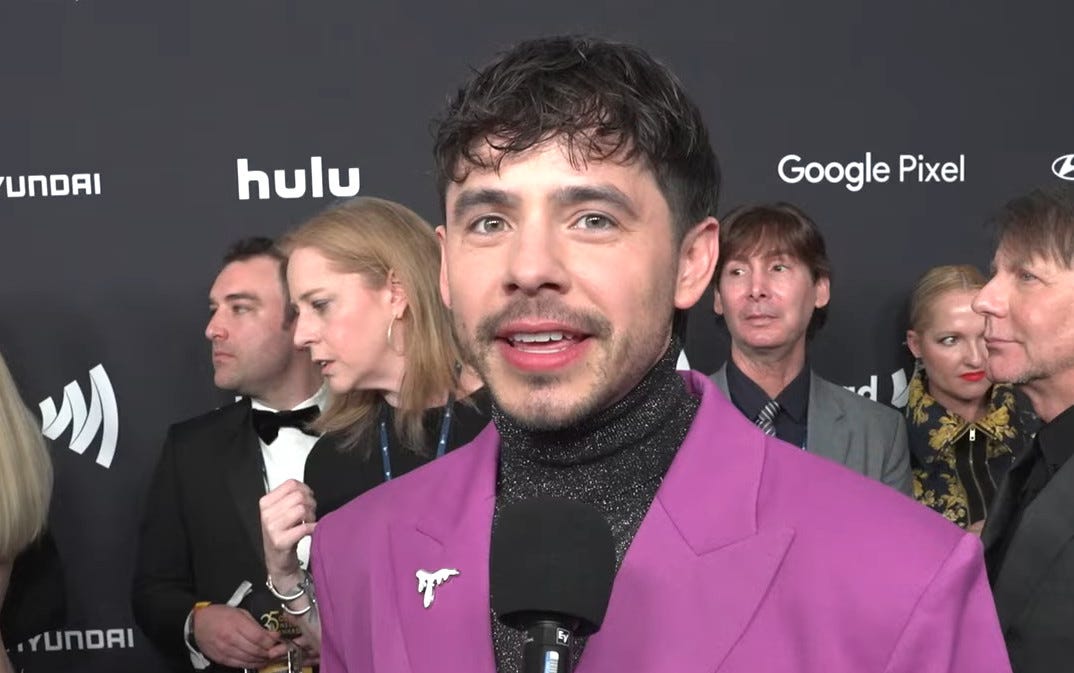
Pop singer Archuleta’s memoir details struggle with parental abuse and religious rejection
Book review: ‘Devout: Losing My Faith to Find Myself’ by David Archuleta, ★★★★✯

Life is difficult growing up gay when your family is steeped in a religion that condemns homosexuality as sinful.
And it may be even more difficult growing up as a adolescent music star with an abusive parent who is living solely for your success.
Such are the lessons to be found in pop singer David Archuleta’s new memoir1, Devout: Losing My Faith to Find Myself. The title does as much as any seven words could to describe the arc of the book: It wasn’t until Archuleta lost faith in his father that he could appreciate his value as a human being apart from his music successes. And it wasn’t until he lost faith in The Church of Jesus Christ of Latter-day Saints2 that Archuleta, who describes himself as a bisexual person attracted to men more than to women, was able to begin to come to terms with his sexuality.
According to his own description of writing the book and the acknowledgments, this book was written by Archuleta with the help of a collaborator, not by a ghostwriter — and the difference shows. By all appearances the words belong to Archuleta: His voice, his personality, his vulnerability, his rawness, they all come through in full force. At times, he speaks as though he’s speaking to a therapist rather than writing what a PR agent might tell him to say; undoubtedly, he found writing this book therapeutic. Frankly, there are times where an English professor might might give him a low grade for disjointed writing as he jumps from thought to thought — but that’s part of what gives the book its authenticity. And even as someone who has become a sort of involuntary spokesperson for LGBTQ persons adversely affected by organized religion, he seems sexually naive even at the age of 34, when he finished writing the book3. He clearly is still trying to figure life out.
And his story is beyond heartbreaking. No child should go through what he had to, being constantly pushed to perform as something other than what he was — or even what he wanted. He certainly wasn’t alone in that regard as he rose to fame through American Idol and other TV shows; in his adolescence and the few years before that, he often got his emotional support not from the adults who supposedly cared for him, but from other young performers who may have been in similar situations. Putting a child through stardom may not be inherently abusive, but in this book it seems to come close.
If you want to know what emotional abuse can do to a child, and even to a young adult, there may be few better ways to find out than reading Archuleta’s story. His honesty refuses to spare readers the unpleasant details.
An up-close look at a church’s inner workings
NOTE: The remainder of this review includes significant spoilers regarding Archuleta’s experience with the hierarchy of the LDS church. The spoilers are included in this review because of their newsworthiness to the LDS community.
As a celebrity who became a poster child for the LDS church by going on an unpaid mission, performing in high-profile church activities and becoming known for following the church’s conservative standards even as a nationally known entertainer, Archuleta had greater access to his church’s hierarchy than typical members could ever hope to have. He even became friends with Elder Russell Ballard, who was the acting president of the Quorum of the Twelve Apostles, one of the highest-ranking and most senior leaders in the church.
According to Archuleta, what Ballard told him were things that no leader of the church has ever said in public. According to Archuleta, Ballard told him it was OK for him to date men (without sexual relations), although Archuleta wasn’t clear whether that was a “hall pass” just for him or for all gay men in the church, who traditionally have been discouraged from doing anything resembling dating. Archuleta said that Ballard said that church leaders reversed a 2015 policy banning the baptisms of children of gay couples because they felt the policy was a mistake4. And Ballard, according to Archuleta, said that church leaders have prayed about LGBT policies and have never received answers they were seeking:
Well, David, to be honest, I don’t know much about any of this. We don’t really have the answers on what to do do about LGBT people. We’ve ... prayed about this, but we’ve never received any answers. All we have is the family proclamation that states marriage is between a man and a woman, and they must create children. ... And we have the law of chastity that says not to have sex before marriage. That’s all we have. And we try our best to figure out how to fill the blanks and to make what we think are the right decisions with what we have.
Archuleta writes that he was disappointed to find out that the LDS leaders don’t really know what God wants, as he had always been taught:
I’d always followed the apostles because I, like all faithful Latter-day Saints, believed their messages came directly from God. But that wasn’t true? ... This was the beginning of unraveling of Mormon doctrine.
In a later conversation with Ballard, the apostle seemed to understand better the situation that Archuleta was facing. Ballard talked about how important it is to have in-depth conversations that lead to understanding. He even offered to arrange a time for Archuleta to meet with a few other apostles.
But the meeting never came.
What happened? Archuleta seems convinced that he was intentionally ghosted, and signs of bitterness are evident in his writing. Whether Archuleta really was ghosted, or whether Ballard might have still been trying to arrange a meeting before he died in 2023, is impossible to know unless private conversations or journals eventually become public.
One interesting final note: In part because the way Archuleta was treated, many of his family members resigned from the LDS church. But he did not:
I left my name on the [membership] list as a symbolic gesture. My door was still open, for conversation about gays in the church, if they wanted to have it.
So it may well be, even if unlikely, that the final chapter about Archuleta’s dealings with the church that, from his perspective, betrayed him has yet to be written.
Archuleta and a ghostwriter also wrote a 2010 memoir, Chords of Strength: A Memoir of Soul, Song, and the Power of Perseverance. In his new book, he disavows much of the first book’s contents for not telling the full story of what he was going through.
Popularly known as the Mormon church, although the church has disavowed use of the nickname.
As of this writing, he is 35.
That the policy was a mistake has never been acknowledged by church leaders, who changed the policy without fanfare. The church’s current president, Dallin Oaks, who was not leading the church when the anti-gay policy was adopted nor when it was reversed, said in 2015: “I know that the history of the church is not to seek apologies or to give them.” He later told the Salt Lake Tribune: “I’m not aware that the word ‘apology’ appears anywhere in the scriptures — Bible or Book of Mormon. The word ‘apology’ contains a lot of connotations in it, and a lot of significance.”

