

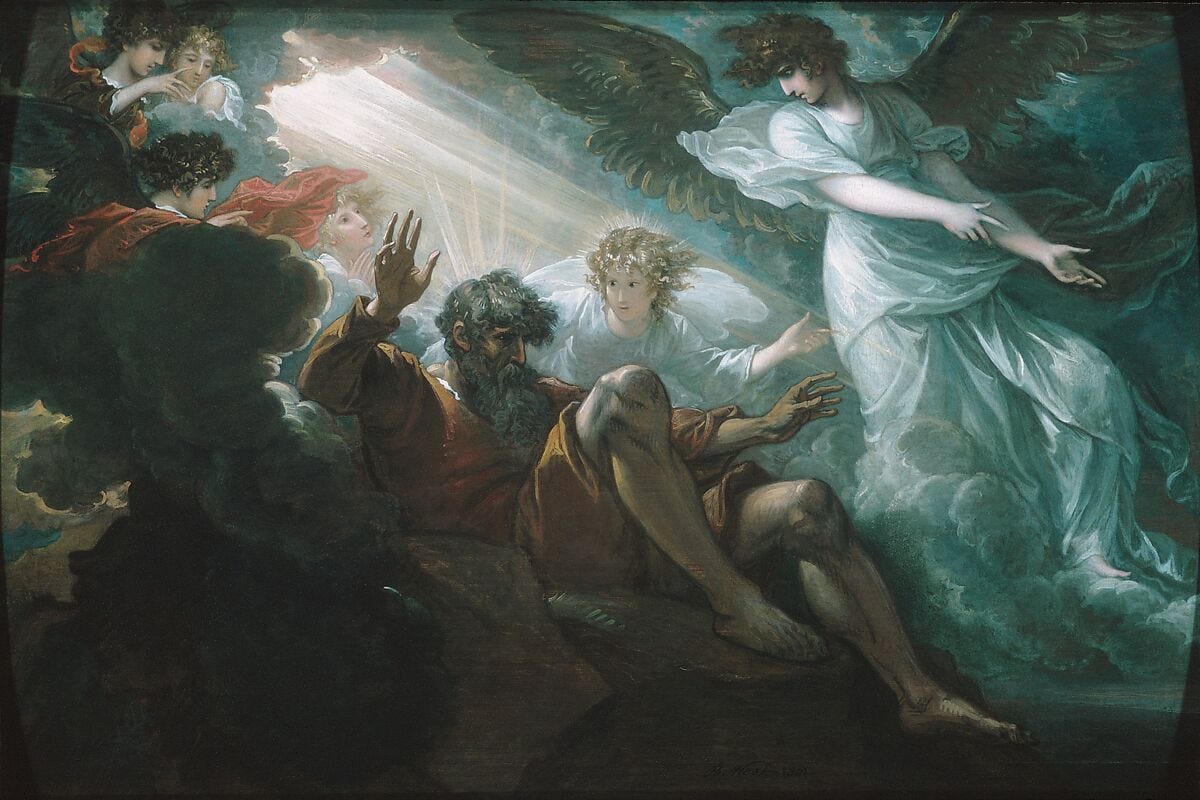
When we think about how the first five books of the Bible came to be, we might imagine Moses sitting in a tent with pen and papyrus in hand and writing a Hebrew version of what we have today.
But that may not be how it happened.
In fact, the origins of these books — often known as either the Pentateuch or Torah, often as simply the Books of Moses — have been the subject of sometimes heated debate for well over a century.
Explanations of the books’ origins range all the way from the traditional one, in which Moses wrote almost essentially what we find in Bibles today1 to the views of many historians that Moses was a person of legend rather than of history and that the books were developed by a series of authors and editors.
The debate over the historicity of Moses is beyond the scope of his article. Suffice it to say that the story we have of Moses comes exclusively from the Bible; there are no ancient Egyptian records of him, no writings of contemporaries that mention him, no archaeological proof. But even for secularists, there are some intriguing hints about his existence that go beyond the Pentateuch and the collective memory of the Biblical Israelites: Most notably, the name Moses appears to be of Egyptian origin; note how it ends in “-ses” as do Egyptian names such as Ramses. And some historians have suggested that there could be a connection between Moses and the definitely historical Egyptian pharaoh Akhenaten, an early proponent of monotheism or monolatry.2
In any case, the view that Moses was the author of the Pentateuch goes back to before the time of Christ, even though the books were anonymously written, as were the other books of history and most books of poetry in the Old Testament.
In the New Testament, portions of the Pentateuch were ascribed to Moses. For example, in Mark 12:26 Jesus says:
But about the dead, that they are raised, haven’t you read in the book of Moses about the bush, how God spoke to him, saying, ‘I am the God of Abraham, the God of Isaac, and the God of Jacob’?
And in Acts 15:21, James says:
For Moses from generations of old has in every city those who preach him, being read in the synagogues every Sabbath.
The passages don’t clearly point to a belief that all the text of the five books was written by Moses, but then again in that culture authorship wasn’t a big concern. It wasn’t until the development of the Talmud, a collection of Jewish writings developed in the third through fifth centuries CE, that Jewish theologians explicitly attributed the books to Moses.
Origins of the documentary hypothesis
And that was the consensus view of both Christians and Jews for over a millennium. It wasn’t until the 1800s that scholars, seeing less unity in the Pentateuch than might be expected from a single author, started seriously questioning whether the Pentateuch was written by one person. The best known of such scholars was German professor and theologian Julius Wellhausen, who popularized what has become known as the documentary hypothesis.
According to the hypothesis, the Pentateuch is a compilation of documents written by four independent sources: the Yahwist (J), the Elohist (E), the Priestly (P) and the Deuteronomist (D). Based on these names, the hypothesis is sometimes called the JEPD or JEDP hypothesis.
The theory is that each of the documents emphasized the interests of its sources; for example, the Yahwist source used Yahweh (sometimes referred to as Jehovah in English) as the name of God, while the Elohist source used the name of Elohim.
Here are three examples of how proponents of this hypothesis see the different sources used in Genesis:
🟪 Genesis 1:1-2:3 by the Elohist explains how Elohim created the world and its living things in six days, while the Yahwist in Genesis 2:24 and following verses gives an account of Yahweh creating the world with a focus the creation of a man followed by the creation of animals and then a woman.
🟪 The story of Noah and the ark seems like a mixture of Yahwist and Priestly accounts, with seven pairs of animals entering the ark in the Yahwistic portion and two of each kind in the Priestly part. The Yahwistic account indicates that Noah sent a dove out in order to find out whether the ground was dry, while in the Priestly account Noah simply removed the boat’s covering and looked around.
🟪 The Ishmaelites take Joseph to Egypt in Genesis 27:28, but in verse 36 it appears that the Midianites did. The first version is typically ascribed to the Yahwist source, the second to the Elohist.3
The documentary hypothesis was the dominant view of Biblical scholars for around a century despite constant disagreement over details, including major ones such as whether there were really four sources, when the sources originated and which passages came from which sources.
A new theory emerges
Beginning in the late 1900s, problems with the hypothesis led many scholars to abandon it to what has become known as the supplementary hypothesis. In this view, the Pentateuch may have begun as a single group of writings, but editors added to it over the centuries. (Sometimes these editors are referred to as an R source, for “redactors.”)
There’s a huge overlap between the documentary and supplementary hypotheses, as both see a final document with sections that indicate the development of Israel’s theological belief. And both theories see the Pentateuch not taking its final form until well into the post-Exilic period, centuries after the Exodus.
Meanwhile, fundamentalist and many evangelical scholars point to the weaknesses in these hypotheses and continue to defend their view that the Pentateuch is essentially the work of Moses while accepting that what we have today may include minor additions or changes made after his death.
In the end, what we’re left with is a mystery as to the Pentateuch’s origins; there certainly is plenty more to be discovered. What isn’t a mystery is the importance of the Pentateuch to both Jewish and Christian thought.4 Moses is mentioned more often in the New Testament than any character other than Jesus, and the significance of the laws based on divine revelation through Moses form the backdrop for the life of Jesus and letters of Paul. It is the Pentateuch that tells us how the world was created, how sin and misery entered the world, how Abraham would become the father of nations, and how the Jews established monotheism in a territory that had been divided by competing gods. The rest of the Bible would make little sense without those five initial books.
This commentary on Genesis and the remainder of the Pentateuch is part of our Bible for Modern-day Saints series. Biblical quotations are adapted from the World English Bible, which is in the public domain.
Traditionalists often acknowledge that the final portion of Deuteronomy, which tells of Moses’s death and sings his praises, could have been added to Moses’s text by Joshua or some other later prophet. Some, however, believe that God revealed to Moses details of his death and future reputation.
Monotheism is the belief in one god; monolatry is the worship of one god without denying that others exist.
Those believing in Mosaic authorship have explanations for these and other apparent anomalies. For example, they often see what happens starting in Genesis 2:24 as an expansion of what was written about earlier.
Additionally, Moses is the one of the most important prophets of Islam, just behind Muhammad, and is mentioned at length in the Quran.