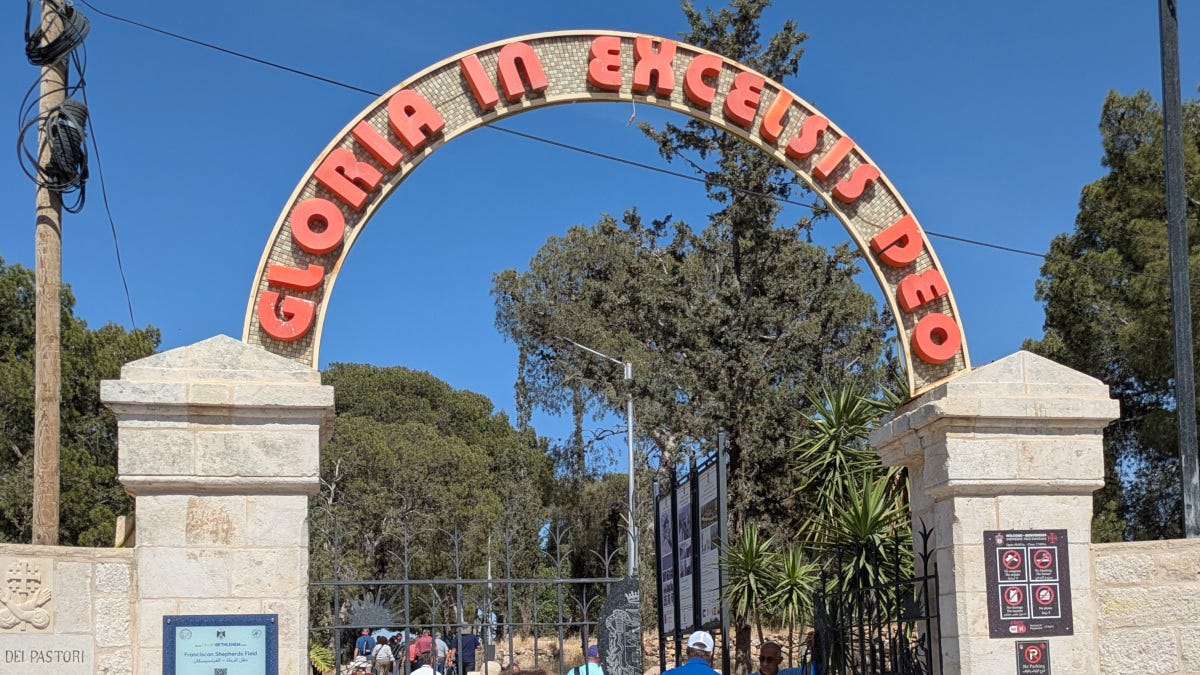
As Gaza war sees shaky ceasefire, Bethlehem resumes welcoming visitors for Christmas
City’s main industry, tourism, has been decimated by covid and regional conflict

After two years of subdued observances, Christmas has returned to Bethlehem.
But the crowds that turned out for the lighting of the Christmas tree on Dec. 6 were nowhere near as large as those that flocked to the city three years ago and that used to come to the city before the covid epidemic to celebrate the birth of Jesus. Major celebrations were canceled during the pandemic and then again in 2023 and 2024 as the Israel-Gaza war kept most international tourists away from Israel; Israel’s, and therefore Bethlehem’s, tourism has been very slowly recovering since a ceasefire went into effect Oct. 10. Despite occasional military attacks, the ceasefire has mostly held.
Bethlehem is a Palestinian city of about 30,000 people about 10 kilometers (6 miles) south of Jerusalem. Although it is ruled by Palestinian authorities, Israel controls ingress and egress as part of its military occupation of the West Bank. The economy is largely dependent on Christian pilgrims who come to see the city where, according to the Gospels of Matthew and Luke, Jesus was born. The majority of residents are Muslim, although the city also has a shrinking Christian minority.
Even this year’s celebrations were more low-key than they have been in the past, when the lighting of the Christmas tree in Manger Square was accompanied by fireworks and street parties. There were no fireworks this year, and the observances were largely limited to the singing of Christmas carols.
Al Jazeera1, a regional news service that serves a mostly Arabic audience and is partly funded by the government of Qatar, quoted Samir Hazboun of the Bethlehem Chamber of Commerce saying that the number of visitors to Bethlehem are down about 90 percent from two years ago, and that the vast majority of those participating in the celebration so far this year are Palestinians rather than international visitors. “We anticipate about 3,000 visitors a day until year-end, which will increase hotel occupancy – currently at just 20 percent among foreign tourists,” Hazboun said.
Hazboun said that the unemployment rate in Bethlehem is about 34 percent, and that about 40 percent of the city’s residents are struggling to survive. Christmas tourism should help, but even so the number of tourists will be limited. He said: “We anticipate about 3,000 visitors a day until year-end, which will increase hotel occupancy – currently at just 20 percent among foreign tourists.”
Bethlehem’s mayor, Maher Canawati, told Al Jazeera that the city decided light the Christmas tree this year because residents “wanted to revive hope for the people of Bethlehem and all Palestinians, and to send that hope to Gaza and to the world. ... As Bethlehem lights its Christmas tree, it ... tells us that hope is a strength,” although the “suffering and destruction in Gaza remain in our hearts. People remember the glimmer of light even amid devastation.”
Fabien Safar, a guide and director of Terra Dei, which organizes pilgrimages to Israel and Palestine, told the Times of Israel that foreign visitors have been coming mostly from Asia, South America and eastern Europe.
Safar said seen bookings start to increase for 2026, but he doesn’t expect a major recovery until 2027, but “this obviously depends on how the situation evolves” with Gaza and the ongoing conflict in Lebanon.
Quotes from Al Jazeera in this article are from Bethlehem’s Christmas tree lights up after two years of darkness and Bethlehem lights up Christmas tree amid hopes for economic recovery.

