

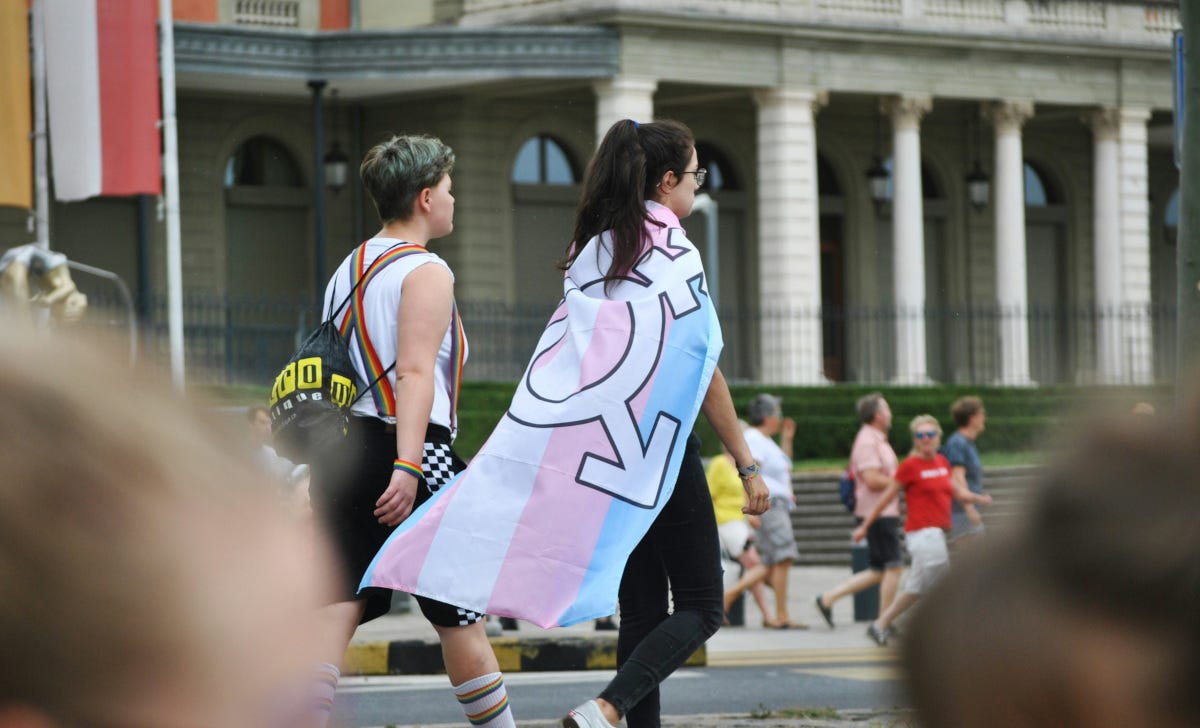
As most deadlines have passed for lawmakers and petitioners to place measures on state ballots for November’s elections, conservative Christian voters and their allies have succeeded in sending to voters in five states measures that would restrict the ability of transsexuals to express their self-identified gender in various ways.
Specifically, at issue in November elections would be plans to limit the ability of trans females1 to participate in school sports for girls or college-age women, prohibit certain transition treatments for minors, and/or restrict the use of restrooms and locker rooms based on sex.
The state that most recently was added to the list of those with a trans-related measure on the November ballot was Nebraska, where a record-setting 211,000 signatures were turned in at the end of June for the proposed Nebraska Sex Requirement for School and College Sports Amendment, which would amend the state’s Constitution. Although state officials have yet to certify that sufficient signatures were turned in, it is a virtual certainty that the requirements were met: Under state law, about valid 126,000 signatures were needed, meaning that organizers approached getting double the requirement. An unprecedented number of signatures would have to be invalidated to keep the proposal off the ballot.
Most of the measures in the five states have advanced to the ballot with support from Catholic organizations and/or evangelical groups such as Focus on the Family. Nearly all are facing opposition from the American Civil Liberties Union, Planned Parenthood and/or LGTBQ groups.
A closer look at the Nebraska proposal
The Nebraska amendment would apply to public schools through the university level. Schools would be required to designate all athletic teams or sports “based on biological sex” as being for males, men or boys; females, women or girls; or coed or mixed. Essentially, the female teams would not be open to biological males, although both male and mixed-gender sports would be open to females.
The amendment does not define “biological sex.”
The campaign for signatures was organized by Fairness for Girls under the auspices of the Nebraska Family Alliance. The alliance describes itself as a nonprofit policy research and educational organization “advocating for Biblical values, marriage, families, life, parental rights, and religious freedom.” The organization says its vision is that Nebraska be a state “where God is honored, marriages and families thrive, life is cherished, parental rights are protected, and religious liberty flourishes.”
At last report, Fairness for Girls had received $3.1 million in cash contributions for its campaign, all of it from Restore the Good Life Inc. Little is known about Restore the Good Life, a 501(c)(4) nonprofit that does not maintain an online presence. As a “dark money” organization, it is not required to publicize its sources of income and has more flexibility to be involved in political campaigns than do the better-known 501(c)(3) nonprofits.
According to Nebraska Public Media, the group’s treasurer, Tanner Lockhorn, did not respond to repeated questions about the organization. Nebraska Public Media also said that in the 2022 election cycle, Restore the Good Life was the sole source of income for the Say No to RINOs PAC, which spent money opposing moderate Republican gubernatorial candidate running in the primary against Gov. Jim Pillen,
As of the most recent campaign-filing reporting deadline, there was no organized opposition to the amendment. Organized opposition could develop now that the amendment appears to have qualified for the ballot.
Measures on ballots in other states
The other states with trans-related measures on the ballot this fall are Arizona, Colorado, Missouri and Washington. Colorado voters will face two measures.
Here’s a quick look at the proposals:
Arizona: Protect Girls’ Sports in Arizona Act
A proposed law that would make changes designed to require trans students in athletic activities to compete with members of their biological sex was approved by the Arizona Legislature earlier this year and sent to voters for adoption. The proposed law, which covers both K-12 public schools and the college system, would make these two changes to state law:
🟪 Prohibit schools and athletic associations (private sports-related organizations that work with schools) from authorizing students and others of a particular sex to use a restroom, locker room, shower room, or other private space that is not designated for their sex. Current law is silent on that issue.
🟪 Provide that only males could participate on sports designated for males. Current law allows females to participate in male sports. The existing ban on males in female sports would continue.
The law defines defines a student’s sex as “biological status as male or female as recorded at birth on the individual’s original birth certificate.”
Groups that have formally endorsed the measure include the Center for Arizona Policy and Liberty Counsel Action. Opponents include the Arizona Education Association (a teachers union), the ACLU and several LGTBQ-oriented organizations.
To date, no campaign expenditures have been reported for either side2.
Colorado: Protect Women and Girls Sports Act
Colorado Initiative 109 is designed primarily to keep biological men and boys from participating in girls’ and women’s athletics. It also would prevent females playing on male teams except when a school or athletic program doesn’t provide the same sport for females. The proposal applies to public K-12 schools as well as the state’s college and university system.
The proposal was placed on the ballot by petition.
The initiative defines a female (a term including women and girls) as someone “whose biological reproductive system is organized around the production of ova.” A male is defined as someone “whose biological reproductive system is organized around the production of sperm.”
The main organizations supporting the campaign so far are the Colorado Catholic Conference and Focus on the Family. The main opponents are the Interfaith Alliance, Planned Parenthood of the Rocky Mountains, and several LGTBQ-oriented groups.
At last report, opponents had raised nearly $600,000 to campaign against the measure, much more than the $116,000 raised by supporters.
Colorado: Protect Children from Irreversible Sex Change Surgery Act
Colorado Initiative 110 is the result of a petition drive that was organized in 2025 in response to the Colorado Legislature’s adoption that year of the Protect Access to Gender-Affirming Health Care Act, which prevented insurance companies from denying coverage for certain types of gender-affirming care. The initiative is aimed at that law as it applies to children, prohibiting most surgical gender-affirming care for minors.
Specifically, the proposed law would provide that health care professionals could not “perform, prescribe, administer, or provide any surgery to a minor for the purpose of altering biological sex characteristics.” It also would prevent health insurance or public health programs from paying for such surgeries.
The initiative makes exceptions for male circumcision and for children “born with a medically verifiable disorder of sex development or treatment for acquired physical or chemical abnormalities.”
The campaign-finance reports for Initiative 110 mirror those for Initiative 109, which opponents far outpacing supporters.
Missouri: Prohibit Abortion and Gender Transition Procedures for Minors Amendment
Missouri Amendment 3, which would change the state Constitution, tackles both abortion and medical or surgical gender transition treatments for minors. It was placed on the ballot by the Missouri Legislature last year on a 103-51 vote in the House followed by a 21-11 vote in the Senate. Only a simple majority was required in each chamber.
Specifically, Amendment 3 would make these changes:
🟪 Repeal the constitutional right to reproductive freedom that voters approved in 2024.
🟪 Prohibit most abortions except in cases of medical emergency, fetal anomaly, rape or incest. Abortions in cases of rape and incest would be permitted only through the first 12 weeks of pregnancy.
🟪 Prohibit gender transition surgeries for minors as well as the use of cross-sex hormones or puberty-blocking drugs for the purpose of gender transition.
Major supporters of the measure include the Missouri Catholic Conference and Missouri Right to Life. Opponents include the ACLU, Planned Parenthood and the League of Women Voters.
With about $5.2 million in contributions as of the last report, opponents are far outpacing supporters in building a campaign war chest. Supporters have raised about $1.6 million.
Washington: Defending Equity in Interscholastic Sports Act
Initiative Measure No. IL26-638 is designed to prohibit students it defines as biologically male from competing in school athletic activities intended for female students only. It would enforce the provision in part by requiring students wishing to participating in female athletics to provide a statement from a healthcare provider verifying that the athlete is biologically female.
The proposed law provides that the statement of biological eligibility could be based only on one or more of the following: “The student’s reproductive anatomy, genetic makeup, or normal endogenously produced testosterone levels.”
An organization known as Let’s Go Washington has been organizing the campaign with support from groups such as Moms for Liberty, the Washington State Catholic Conference and XX-XY Athletics. Let’s Go Washington had raised nearly $7 million at last report.
Opponents have raised nearly $1.7 million through an entity called No Hate in WA State. Opponents include the ACLU, the Washington Education Association and several LGTBQ interest groups.
As used in this article, a trans or transsexual female is someone whose sex was designated as male at birth. Some states and proposals may use criteria other than designation at birth to determine how laws are applied.
Campaign expenditures listed in this article are based on reporting by Ballotpedia.