

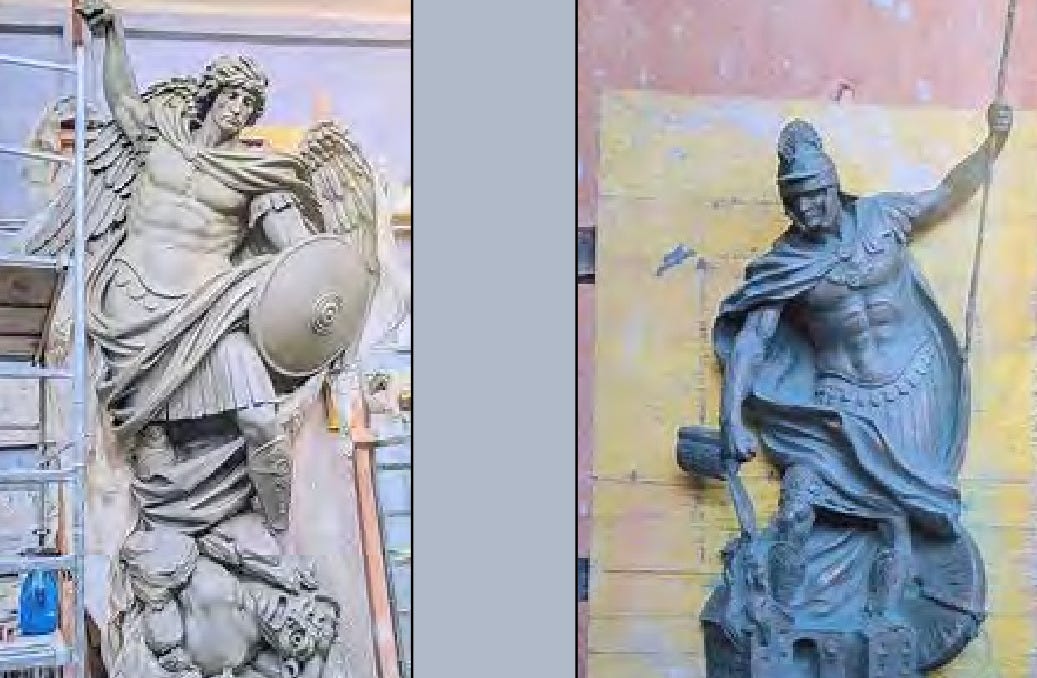
For centuries, Saint Florian has been seen as the patron saint of firefighters and chimney sweeps, while Saint Michael has been the patron saint of police officers and military personnel. And so it was that the mayor and staff of the city of Quincy, Mass., decided a few years ago to commission a pair of bronze statues of the two saints to adorn the city’s new public-safety building.
But the city’s plans to place the statues of the saints, a move that has the support of national firefighting and police associations, hit a roadblock recently as the Massachusetts Supreme Judicial Court ruled that the city’s plans violate the state Constitution. The court unanimously found that the city’s plans would probably be “perceived as government endorsement of a particular religion.”
The Massachusetts Supreme Court is the highest court in the state, so any appeals of the ruling would have to be taken to a federal court, possibly the U.S. Supreme Court. Although its appears that an appeal is likely, the city could face legal difficulties in an appeal because the ruling was based primarily on state rather than federal law. The state Constitution is more limiting than the First Amendment to the U.S. Constitution, providing that:
... all religious sects and denominations, demeaning1 themselves peaceably, and as good citizens of the commonwealth, shall be equally under the protection of the law; and no subordination of any one sect or denomination to another shall ever be established by law.
Technically, the court’s decision sent the dispute back to a state superior court, which had issued a preliminary injunction as result of a lawsuit by opponents of the statue to halt the city’s plans, so any appealable resolution of the matter is at least a few months away. That lower court had found it “likely” that the statutes were a constitutional violation.
That a city would consider using representations of Florian and Michael in connection with public safety isn’t particularly surprising. Firefighters in many parts of the country, including Massachusetts, use the “Florian cross,” a symbol that looks something like a four-petaled flower, for badges or emblems, and International Firefighters Day is celebrated on May 4, the Saint Florian feast day. And it isn’t unusual for police officers who have tattoos related to their profession to use one of Michael as a symbol of valor.2
The city staff had approved plans for the statues and spent about $761,000 on them before details on them became widely known. After a newspaper published details of the plans in February 2025, opponents started collecting signatures against them and packed a City Council meeting to urge members to reject the plans. The Interfaith Network also told the city it had “grave concerns” about the statue part of the project. After the council declined to change the plans, opponents filed a lawsuit three months later with the support of the American Civil Liberties Union and other groups known for their advocacy of church-state separation.
In making their case to the Supreme Judicial Court, the city had the support in the form of 13 amicus curiae or “friend of the court” briefs from a wide range of organizations including the Massachusetts Family Institute, the International Association of Firefighters and Professional Firefighters of Massachusetts, the National Fraternal Order of Police and Mass Fraternal Order of Police and various religious organizations such as the The Islam and Religious Freedom Action Team, the Jewish Coalition for Religious Liberty, and the Knights of Columbus. Many of the briefs argued that the lower court’s rejection of the statues represented an impermissible hostility to religion.
Opponents of the statues were represented by an amicus curiae brief filed by the American Humanist Association with the support of various Muslim, Hindu, Jewish, Unitarian and Christian groups. It argued that placement of the statues would represent government favoritism toward a single religious tradition and harm religious minorities and nonreligious people.
No decision will be made on a possible appeal until the lower court has made a final ruling to implement the top court’s decision.
“Demeaning” in this context means “behaving.”
Florian was martyred around the year 304. According to popular accounts, Roman authorities threatened to burn Florian at the stake, but he said he wasn’t afraid of the fire and so instead was drowned with a millstone around his neck. He is often pictured as using a bucket of water to douse a fire. Michael, on the other hand, is mentioned in the Bible as an archangel. In Catholic tradition, he ousted Satan from Paradise and thus has become a symbol of fighting evil.