

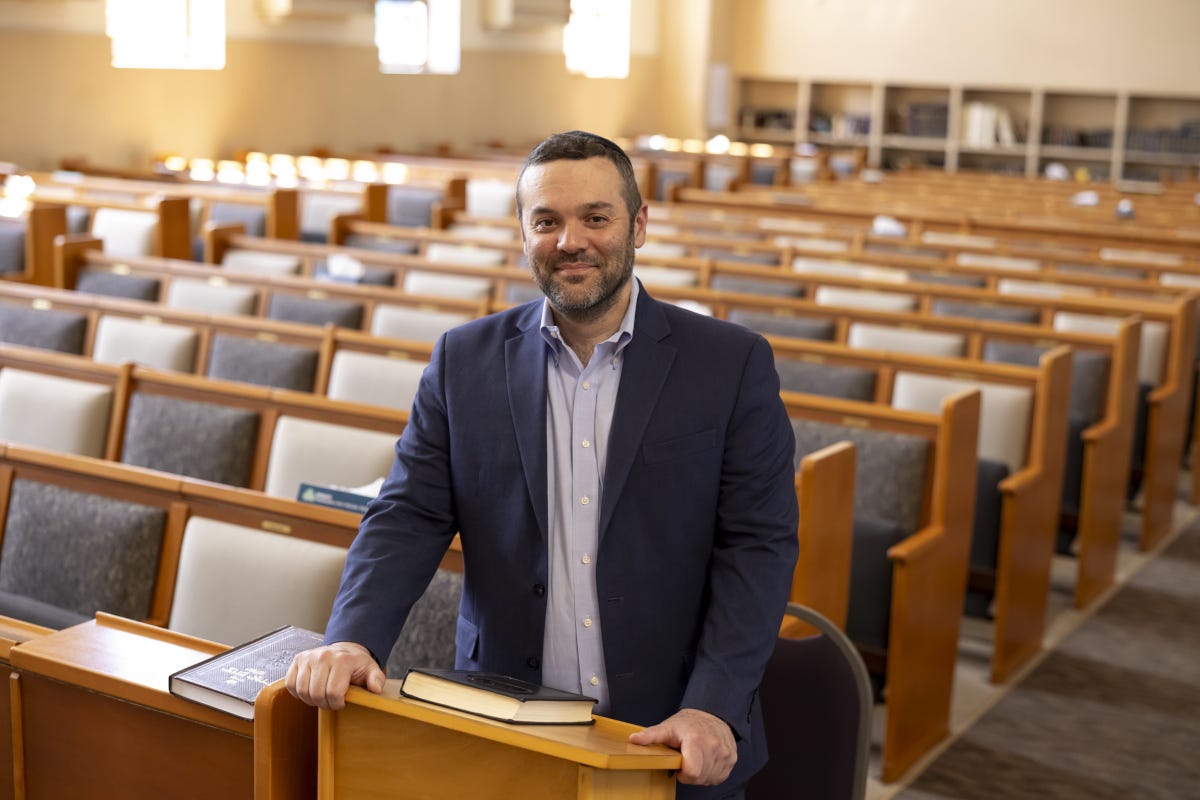
Rulings on birthright citizenship and transgender rights received all the attention Tuesday as the U.S. Supreme Court also announced that it had decided to accept the case of an Orthodox Jew who claims he was harassed in his attempts to organize regular meetings of other Jewish men in his home.
The case is Grand v. City of University Heights, and it becomes the second case related to religious issues that the court has agreed to hear during its 2026-27 term that begins in October. The other is St. Mary Catholic Parish v. Roy, where a Catholic preschool is trying to get admitted to Colorado’s state-funded universal preschool program. The court added that dispute to its 2026-27 roster in April.
No date has been set for either of the cases to be heard.
Here is a quick overview of the two cases:
Grand v. City of University Heights
According to the account of Daniel Grand, an Orthodox Jew living in University Heights, Ohio, he emailed a dozen male friends in January 2021 asking them to join him in prayer as a minyan, a group of at least 10 Jewish men, on a Saturday. Before the minyan could convene, however, city officials got wind of the planned meeting and sent a cease-and-desist letter telling him he couldn’t use his home in a residential zone as a place of religious assembly.
Grand then applied for a special-use permit but was confronted with what his lawyers called “a rugged process using an adversarial ‘quasi-judicial approach.’” He then withdrew the permit application saying he had no desire to operate a house of worship as defined by city ordinance. According to his petition to the Supreme Court, Grand was then threatened with legal action if gatherings “consistent with” religious use were held in his home, and that the mayor asked neighbors to report if there were any such activities. Grand notes in legal papers that Orthodox Jews don’t drive on Saturdays, so the men would have arrived at his home on foot, creating no traffic problems, and that such gatherings would have no more effect on neighbors than someone inviting a similarly sized group over for card games.
Grand then went to federal court seeking legal relief but was denied by the trial court and the Sixth U.S. Circuit Court of Appeals before filing a petition with the Supreme Court. The main legal issue in the case is whether “a credible government threat that deters the exercise of fundamental rights constitutes a complete and independently actionable constitutional injury.”
The city, however, said in its legal document asking the high court to reject the appeal that it would be premature for the high court to decide in Grand’s favor:
While Grand claims he subjectively felt he could not pray in his house the way he wanted, this record did not support that he was precluded from doing so, as there was no enforcement action against him, he used the house in the manner he wished, and Grand remains free to file a new action if the City applied the ordinance to him in a way that violates his statutory or constitutional rights.
Grand is represented in part by the Alliance Defending Freedom, one of the major law firms involved in religious-freedom cases.
St. Mary Catholic Parish v. Roy
This case involves a lawsuit by two Catholic parishes in Littleton and Lakewood, Colo., and the Archdiocese of Denver, which operate a preschool, against the state of Colorado. Two parents, Daniel and Lisa Sheley, are also plaintiffs. Specifically, the defendants are Lisa Roy, the executive director of the Colorado Department of Early Childhood, and Dawn Odean, director of Colorado’s Universal Preschool Program.
Roy’s department launched the preschool funding program in 2023, providing eligible families with about $6,300 to cover the costs of 15 hours per week of preschool. The program was designed to give families the flexibility to enroll their children at public, private, or faith-based preschools.
According to the Becket law firm, representing the plaintiffs, 1,500 children attending 30-some Catholic preschools were excluded from the program because the schools limit enrollment to Catholics. But, the lawyers say, various secular preschools have also limited who is eligible to attend, calling this a double standard.
The state argued in response to the plaintiffs’ Supreme court petition that it is not applying a double standard, that it is seeking “to ensure, through a neutral and generally applicable program, that preschoolers have equal opportunity to enroll in and receive publicly-funded preschool services regardless of their, or their parents’, protected-class status.” In fact, Colorado described itself as “a national leader in providing universal preschool through a ‘mixed-delivery system’ that affirmatively includes faith-based providers.”
During upcoming arguments, both sides are likely to focus on the applicability of Carson v. Makin, a 2022 ruling that strictly limited how religious groups could be excluded from government programs.