

Does Christianity need government support to thrive — or even to survive? The evangelical right seems to think so.
Politically conservative evangelicals are the most powerful they have been in the history of the United States. They hold enormous sway over the presidency, the House and the Senate. The speaker of the House is one of them. And although the Supreme Court is overwhelmingly Catholic — seven of the nine justices are affiliated with the Vatican-based church — its conservative members have increasingly sided with evangelical activists on matters such as church-state relations, abortion and LGTBQ issues. Although only about a fourth of Americans identify as evangelical, they influence is such that they appear to be acting like a political majority. A recent taxpayer-funded gathering for the celebration of the nation’s 250th anniversary was little more than a full-day evangelical Christian concert and pep rally with less than a handful of token non-evangelicals — but still political conservatives — thrown in the leadership mix.
And yet all this isn’t enough for the evangelical activists: 2026 so far has been an extraordinary year in terms of the relationship between church and state, but perhaps no day carries with it as much long-term significance as last Friday:
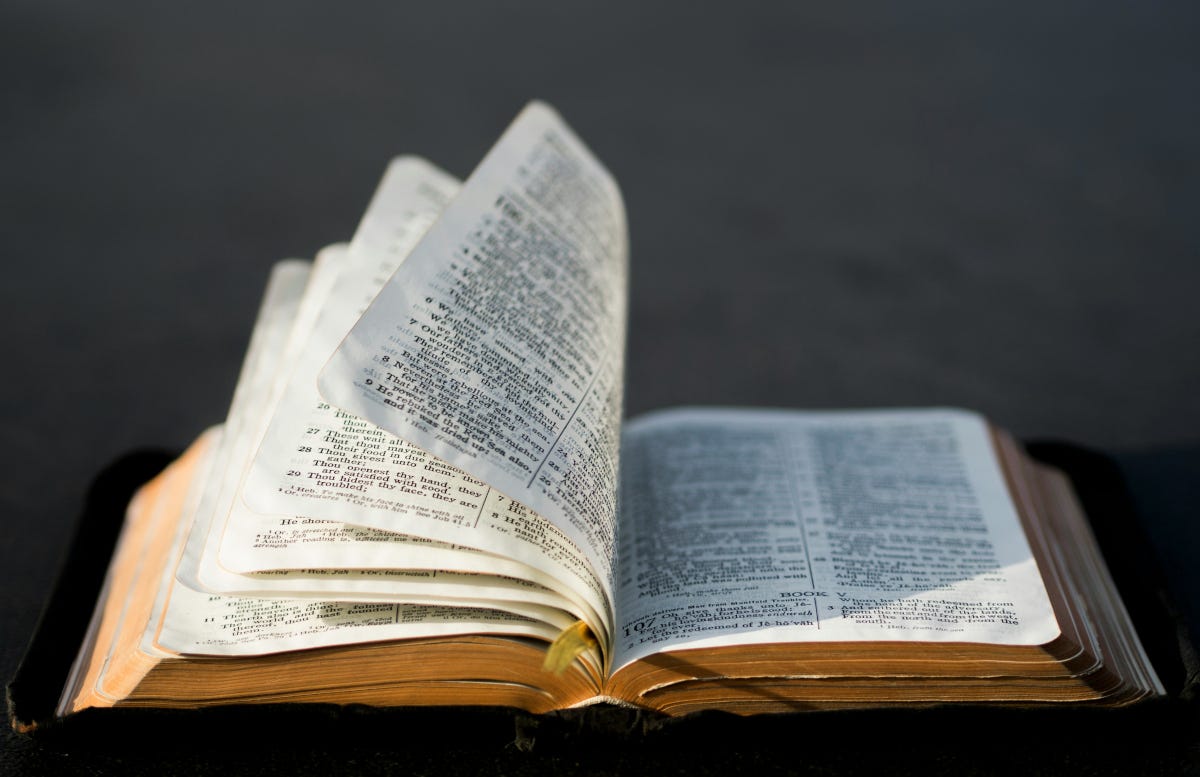
🟪 The Texas Board of Education added Bible selections to its required reading list for its public school students, starting with a storybook presentation of the story of Noah’s ark for first-graders and the love chapter of 1 Corinthians 13 for graduating seniors1. Although many school systems throughout the country for years have used Bible selections in various types of social-studies and literature classes, Texas appears to be the first state to include Bible excerpts in an overall mandatory reading list that includes the secular classics.
🟪 President Donald Trump’s Religious Liberty Commission, led by a Southern Baptist who has proclaimed that there’s no such thing as a constitutional separation of church and state, issued a report that aligns with a long list of evangelical grievances, such as certain laws that require fair treatment for LGTBQ persons and even laws requiring vaccinations.
In a technical sense, that chairman, Texas Lt. Gov. Dan Patrick, is correct: Nowhere does the Constitution use the words “separation of church and state.” But the Constitution, in the First Amendment, does prohibit “an establishment of religion” and demands the “free exercise” of religion. Originally, that amendment applied only to the federal government, but with the passage of the 14th Amendment the restrictions on government power were applied to the states as well.
The First Amendment provides a setup that has largely kept the government out of churches’ (as well as synagogues’ and mosques’) business and kept religious adherents from imposing their will on others not of their faith. Students are free to pray privately before their tests and even schedule gatherings with their fellow believers in the same way that students who share secular interests can do so, and teachers aren’t allowed to dictate what students should pray. And under a federal law known as the Religious Freedom Restoration Act and similar laws in various red and blue states, religious adherents can receive protections even beyond those guaranteed by the Constitution.
Also, under various civil rights laws religious protections are extended to even the private sector: Employers are required to make reasonable accommodations to the religious needs of employees and not discriminate against persons of any religion (or no religion) in their hiring.
In short, we have a type of church-state separation that has worked fairly well, even if not perfectly.
An attempt to tilt the balance
But now, the evangelical, often Christian nationalist, right is seeking to tilt the balance that has developed over the past two centuries. It is hard to see the move by the Texas Board of Education as anything other than an attempt to reinforce conservative Christianity as the dominant religion in Texas. The move comes at a time when state officials have been attempting to limit the influence of Islam, and when the Legislature has promulgated the posting of a sectarian version of the Ten Commandments in public schools.
And the concern here doesn’t come from a belief that the Bible has no place in public education: The Constitution has long been understood to provide for teaching about religion, and no education would be complete without a recognition of the role that religion has played in history and even jurisprudence. It does come partly out of a concern the movement interferes with one of the most sacred or rights, that of parents to direct the upbringing of their children. As a Christian parent whose children are now adults, I would not have wanted the government telling me which parts of the Bible are worthier than others, nor would I have wanted my tax dollars being used to pay teachers to tell my children how they should understand various Bible passages.
And if I were a non-Christian, I wouldn’t want my government teaching my children in ways that suggest that the story of Adam and Eve is anything other than mythology, for example, nor the explicitly religious passages such as the 23rd Psalm or the story of Moses and the burning bush. Don’t get me wrong: I find the 23rd Psalm is one of the most beautiful passages of the Bible, but it’s up to me to teach my children about the gracious God of the psalm, not the job of the government.
Conflation of religion and politics
And I can’t help but note how the Texas board decided not to teach some of the Biblical passages that run counter to the conservative political agenda. No study of the Old Testament (the Hebrew Bible) is complete without noting its passages calling for hospitality toward foreigners, just as no study of the New Testament is complete without learning of Jesus’s admonitions to care for the least of these. But these passages, constantly violated by the supposed Christians in the Trump administration, are nowhere to be seen in the Texas list.
This conflation of political views with religious ones can be seen as well in recommendations made by Trump’s Religious Liberty Commission. Although the 224-page report does pay lip service to liberties for non-Christians, it relies on a distorted historical narrative and gives credence to misleading claims by evangelical Christians that they have been persecuted mercilessly. No doubt there have been evangelicals subjected to ridicule or otherwise mistreated — but in multiple cases in the report of mistreatment by government, even the report acknowledges that the errors have been corrected by courts.
The commission’s recommendations aren’t necessarily mistaken: Of course, it’s a good idea to make clear to school school districts what the religious rights of their students are, and existing unlawful discrimination, which does occur, should not be tolerated. But by focusing on the particular cases it does and bringing up superfluous grievances, the report gives the impression that religious freedom belongs almost solely to one branch of Christianity.
Although they appear to be trying to help Christianity, both the Texas board and the Trump commission are causing harm to true faith by suggesting that faith can’t bring personal meaning and strength on its own without government mandates. The two panels are actually reducing faith to just another political issue rather than recognizing the moral clarity and courage that it offers.
If it survives court tests, the new list takes effect in 2030.