

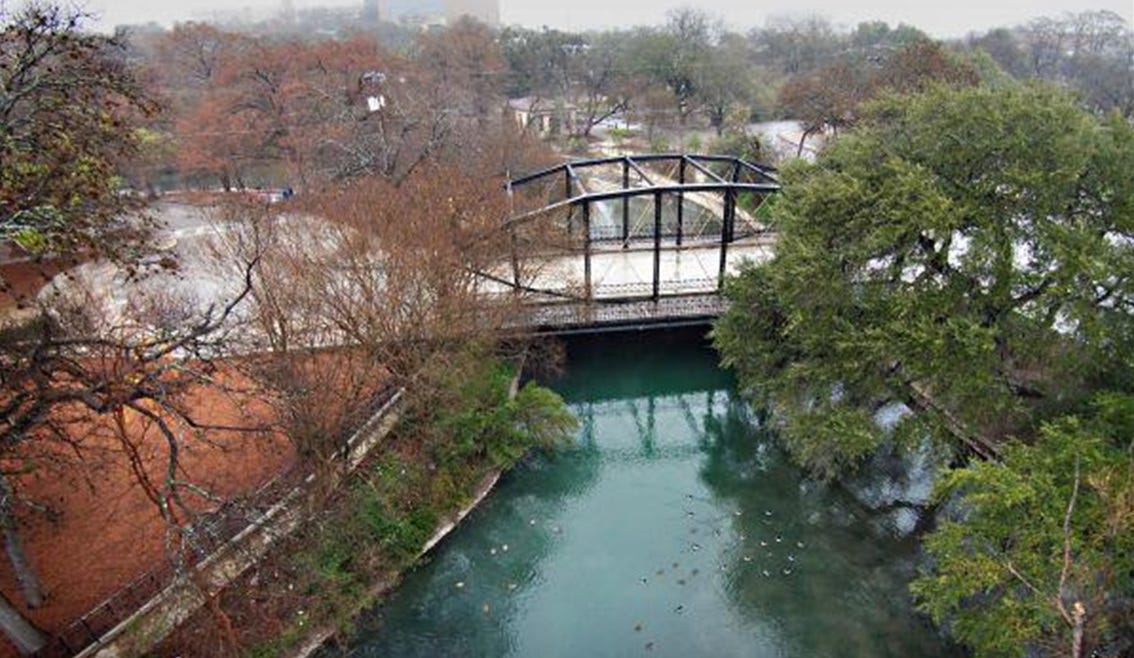
Leaders of a Native American religious organization have gone to the U.S. Supreme Court in their effort to prevent the city of San Antonio, Texas, from continuing with park developments that the group says would irrevocably damage a sacred site that has been used by Native Americans for centuries.
At issue are plans by the city to refurbish a part of Brackenridge Park on a bend of the San Antonio River using funds from an $8 million bond measure that local voters approved in 2017. The plan would involve the removal of some trees that are part of an area where large white cormorants, a type of aquatic migratory bird, annually nest.
Petitioners Gary Perez and Matilde Torres, ceremonial leaders of the Lipan Native American Church, filed suit against the city in the U.S. District Court for the Western District of Texas in 2023 when they and other worshipers were barred from an area of the park due to development work. They claimed that the city’s actions, particularly its removal of trees and efforts to deter the nesting of cormorants, infringed on their religious freedoms. They sought an injunction that would provide them access to the site, preserve the “spiritual ecology” of the site by limiting tree removal and allowing cormorants to nest, and order the city to develop alternative plans that would accommodate the Native Americans’ religious beliefs.
Perez and Torres so far have been unsuccessful in their legal actions. The district court sided with the city, finding, among other things, that the plaintiffs had not established that their religious rights were substantially burdened in light of the city’s compelling government interest in carrying out the park project.
The plaintiffs lost their appeal to a panel of the U.S. Fifth Circuit Court of Appeals, and in February the full appeals court voted 11-6 not to have the entire court rehear the case.
In their petition to the Supreme Court, the plaintiffs, represented by the Liberty Institute with support from the University of Texas Law and Religion Clinic, is asking for consideration of two legal issues:
🟪 Whether the First Amendment allows courts to override the sincere judgment of a claimant’s sincere theological judgment about what religious exercise is required by the religion.
🟪 Whether a government that has the obligation to show that its actions are the “least religiously restrictive means available” has done so if it “failed to consider any workable alternatives prior to litigation.”
Steven Collis, director of the Law and Religion Clinic, said in a prepared statement about the legal action:
Both the courts and the city are aware that our clients can worship nowhere else but this site, yet both have told them they are mistaken in their religious beliefs and can just go somewhere else. That violates the Religion Clauses of the First Amendment, as does refusing to do available, less-destructive alternatives.
Meanwhile, the city attorney’s office earlier said of a ruling favoring the city:
This ruling affirms the City’s ability to responsibly preserve and manage public lands — including the voter-approved 2017 bond project to improve Brackenridge Park — while continuing to respect and accommodate religious practices. We are hopeful that work can begin soon on the long-delayed, voter-approved improvements to Brackenridge Park.
The lawsuit is referred to as Perez v. San Antonio. If the Supreme Court agrees to consider the case, a hearing would probably be held during the term that begins in October.
Lipan religious beliefs explained
As part of the proceedings, the federal appeals court had asked the Texas Supreme Court for its understanding of whether a provision of the state Constitution applied in this case. As part of its ruling, the court gave this explanation of the Lipan religious beliefs:
The Church believes that life on earth began at a spring along the Yanaguana, which is now known as the San Antonio River. A particular bend in the river, which resembles the shape of the constellation Eridanus, serves in the Church’s faith as a sacred connection between the physical and spiritual worlds.
According to the Church’s teaching, the spring created the Blue Hole, in which a spirit in the form of a blue panther resided. Another spirit, taking the form of a cormorant, appeared at the Blue Hole, but the panther spirit startled the bird spirit and caused it to flee, dropping water from its tail that produced life throughout the San Antonio River Valley.
Church members believe that at certain times throughout the year they must participate in certain religious services in the “Sacred Area” — a twenty-by-thirty-foot space among cypress trees on the south shore of the river bend — facing north so they can observe the trees and the cormorants nesting and flying within the “spiritual ecology.”
Evidence exists that indigenous peoples have conducted similar religious services in and around the Sacred Area for thousands of years.1
The Texas Supreme Court said that the city’s project in this case wasn’t a type of government action covered by a religious-freedom provision in Texas Constitution.
Paragraph separations have been added for ease of reading.