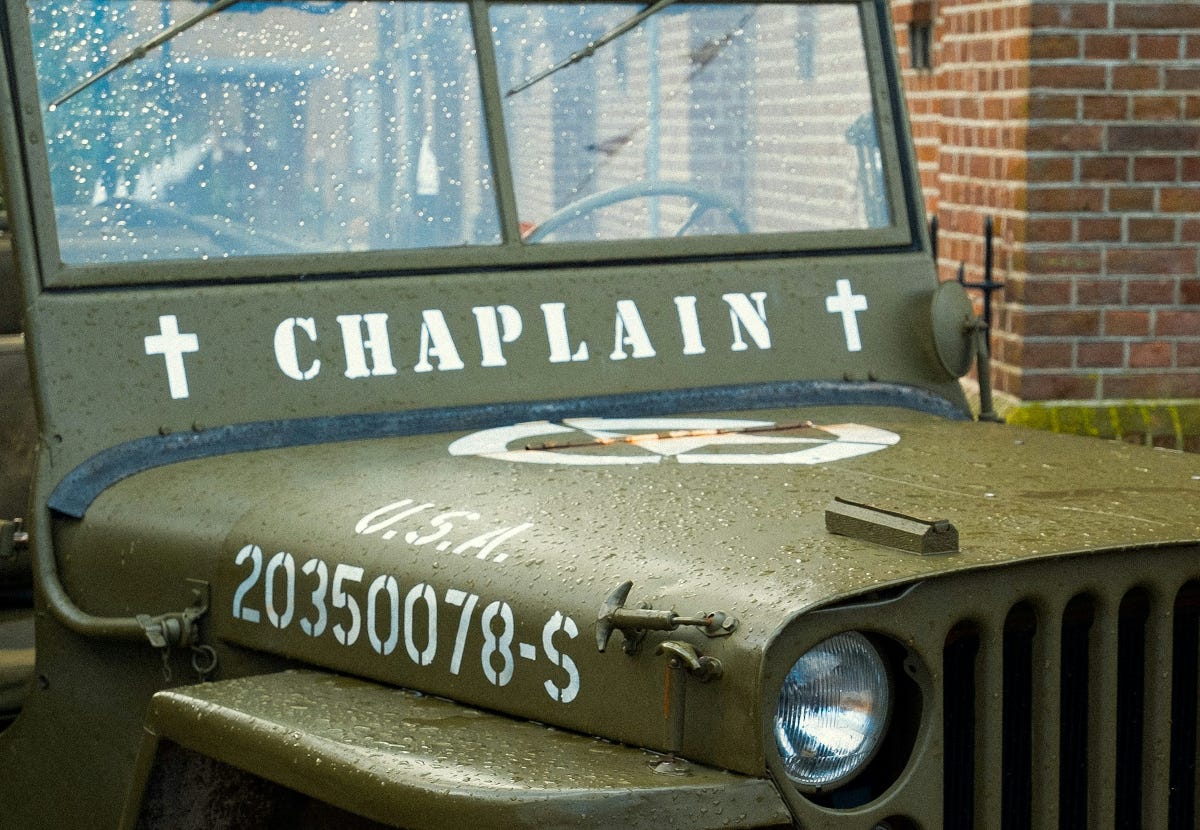
Military chaplains get a sloppily produced list as Pentagon updates religious classifications
Latter-day Saints, Unitarians are among those objecting to their treatment

Ever since Pete Hegseth took over the Department of Defense, it has been accused by its critics of operating in chaos as half-baked plans take effect and policies shift without rhyme or reason.
Certainly politicians and pundits making their partisan talking points will continue debate over whether that criticism is justified, but last week’s slashing of a list of religions recognized by the Pentagon appears to fit that pattern.
The official list appeared to be sloppily made, even spelling the names of two religions incorrectly1. It used theological divisions that made little sense, a step that could make it more difficult for military chaplains to meet the needs of military members — the purpose of the list.
Specifically, the list of religions is used by the military’s chaplains to provide spiritual and counseling support to service members; by law and tradition, the chaplains provide support to service members even when they belong to religions other than their own.
The military formally announced Friday that the list of religions, shown at the end of this article, was being streamlined, reducing the number of recognized faiths from 211 to 31. The list does not affect the military status of personnel and has little use beyond the needs of the chaplaincy.
The changes, which were officially adopted May 20 and signed by Undersecretary of Defense Anthony Tata, were the first made to the list since it was first issued in March 2017. “The new list will provide chaplains with clear, readily available information that will better enable them to anticipate the religious support needs of service members and to provide religious support activities that align with service members’ personal faith and practices,” Tata wrote in a memo.
But will the new list actually be better for chaplains? In shortening the list, the military made two huge changes: First is that the shorter listen inevitably left out a number of religions; while it list did include agnosticism, atheism was left out, as were Wicca, Rastafarianism, Native American religions, Eckankar and, among others, any number of religions that might be loosely classified as New Age. Second is that widely different expressions of faith are lumped into much broader categories than existed before.
For a chaplain, those two changes could make their tasks more difficult if they have a need to know something about a service member’s religious outlook before meeting with him or her. The list seems to assume, for example, that all Presbyterians are alike, but they aren’t. The country’s largest Presbyterian church, the Presbyterian Church (USA) is theologically and socially liberal, even solemnizing same-sex marriages and ordaining pastors to the clergy if they are in a same-sex marriage. But a number of smaller Presbyterian denominations are at least conservative as the mainline Presbyterian church is liberal. The small Reformed Presbyterian Church General Assembly, to use one example, does not allow women to preach or serve as elders and sees homosexual behavior as sinful. A chaplain who prepares to meet the first type of Presbyterian is unlikely to be equipped to meet with the second kind.
Latter-day Saint lawmakers and influencers raise objections
When it came to the list’s handling of the Church of Jesus Christ of Latter-day Saints — putting one of America’s largest denominations in a category of its own rather than listing it as a Christian denomination — the reaction from LDS members using social media was immediate. By the hundreds, maybe thousands, they echoed the thoughts that appeared in a headline of the Salt Lake Tribune: Are Latter-day Saints Christian? The U.S. Defense Department doesn’t appear to think so.
Of course, the LDS church views itself as a Christian denomination, and influencers saw their church’s placement in the list as offensive. Among those joining the fray were Utah’s two U.S. senators, both of them church members.
Said the state’s junior senator, John Curtis on X, formerly known as Twitter:
Latter-day Saints are among the most patriotic, service-oriented individuals in our country. They are also unequivocally Christian — just look at who is in the name of the Church.
It is unacceptable for a government entity to characterize a faith in a manner that contradicts the religion’s own foundational tenets. I am working now to ensure a correction is made.
And Utah’s senior senator, Mike Lee, posted the following above the church’s logo, which features a drawing of Jesus:
If only we, as Latter-day Saints, belonged to a church that had “Jesus Christ” in its name and His image in its logo ...
Oh wait
The idea that Latter-day Saints aren’t Christian stems in part from the fact that the church rejects the Nicene Creed, particularly its formulation of the Trinity2. The debate over whether acceptance of that understanding is part of what it takes to truly call oneself a Christian has been waging for hundreds of years. The Catholic, Orthodox and nearly all Protestant churches hold to the traditional
Trinitarian view of the Nicene Creed.
It’s impossible to know what the LDS church’s views on the Trinity had to do with the way it was listed, but the church to which Hegseth belongs, the conservative Communion of Reformed Evangelical Churches, is one of those that would not be inclined to see Latter-day Saints, nor even some theologically liberal Protestants, as Christian.
Even so, there two denominations listed as Christian in the military list that do not accept the Trinitarian formulation of the Nicene Creed:
🟪 Jehovah’s Witnesses, who believe that Jesus is separate from God.
🟪 Christian Scientists, who teach a strict form of monotheism in which “Life, Truth, and Love constitute the triune Person called God,” according to the writings of church founder Mary Baker Eddy3.
Also in the list of Christians are the Quakers, who are a diverse set of small organizations that grew out of the Christian tradition. However, not all those groups today consider themselves to be Christian or even believe in a personal God.
The LDS church itself has not issued any statement about the military list, nor have any of its top leaders.
Legal implications?
Does the Pentagon’s placement of the LDS church outside its list of Christian churches have any legal implications? Maybe, suggests David French, a New York Times columnist who is an evangelical Christian, critic of Hegseth and former religious-freedom attorney. He wrote on X on Sunday:
The issue with the Pentagon list excluding the LDS church from Christianity has nothing to do with theology and everything to do with the Establishment Clause.
I’ve spent my whole life around Christians who draw different lines around the faith. It’s a 2,000 year-old argument that will continue for another 2,000 years or until Christ comes again. But that’s a church argument, and it’s none of the state’s business.
Concerns come from other religions as well
Latter-day Saints aren’t the only group that has raised questions about the list. One of them that has is a group that didn’t make the cut of the new list, the Unitarian Universalist Association, generally seen as liberal. According to the Associated Press, it said in a written statement: “This may make it more difficult for our uniformed UUs to access the spiritual care that they need.” The denomination said it is working on a strategic response to support UU service members.
And the Rev. Paul Brandeis Raushenbush, a Baptist minister and leader of the Interfaith Alliance, raised similar concerns in a written statement:
Stripping away status from many religious traditions escalates the Trump administration’s Christian nationalist takeover of the Department of Defense. Religious freedom in the military must mean religious freedom for everyone who serves, not just those this administration finds politically useful.
Secretary Hegseth is not “streamlining” anything. He is elevating one narrow religious worldview from the top of the chain of command. That is dangerous, discriminatory and fundamentally un-American. The First Amendment does not allow the government to create a hierarchy of faiths, and it certainly does not allow the Pentagon to decide which beliefs are worthy of recognition.”
Hemant Mehta, who writes as the Friendly Atheist, also raised questions about exclusion on his Substack site:
If you’re an atheist, like I am, the only sensible category would be “No Religion.” What about people who no longer buy into organized religion but still think there’s a Higher Power somewhere up there? They would also be listed under “No Religion.” What about people who never think about religion at all? “No Religion.”
It’s a catch-all term that erases open atheists from the military by lumping them in with people who don’t share their views at all.
Meanwhile, the Pentagon is dismissing concerns raised by its religious critics. In his own written statement Friday, Sean Parnell, a Pentagon spokesperson, said:
This decrease in religious affiliation codes is not designed to make any claims on the legitimacy of any faith or religious belief, nor is it intended to provide a list of “officially approved” religions. Rather, it is designed to allow chaplains to quickly look at the religious composition of their units and determine how they structure resources to best provide for warfighters of all faith groups.
The official list
Here is the current list of religions recognized by the U.S. military for purposes of guiding chaplains. For ease of reading, it has been reformatted and edited for typographical errors:
🟪 Agnostic
🟪 Baha’i
🟪 Buddhism
🟪 Christian (Assemblies of God)
🟪 Christian (Baptist)
🟪 Christian (Brethren)
🟪 Christian (Catholic)
🟪 Christian (Church of Christ)
🟪 Christian (Church of God)
🟪 Christian (Church of the Nazarene)
🟪 Christian (Episcopal/Anglican)
🟪 Christian (Evangelical)
🟪 Christian (Jehovah’s Witnesses)
🟪 Christian (Lutheran)
🟪 Christian (Methodist)
🟪 Christian (nondenominational)
🟪 Christian (Orthodox)
🟪 Christian (other)
🟪 Christian (Pentecostal)
🟪 Christian (Presbyterian)
🟪 Christian (Quaker)
🟪 Christian (Reformed)
🟪 Christian (Christian Scientist)
🟪 Christian (Seventh-day Adventist)
🟪 Church of Jesus Christ of Latter-day Saints
🟪 Hindu
🟪 Islam
🟪 Judaism
🟪 No religion
🟪 Other religions
🟪 Sikh
It incorrectly hyphenated and capitalized the names of The Church of Jesus Christ of Latter-day Saints and the Seventh-day Adventist church.
To simplify, perhaps overly so, the traditional belief in the Trinity states that there is one God existing in three Persons united in one substance. The LDS belief is in a Godhead made up of three divine beings who are united in purpose but are not of the same substance. The three persons/beings are recognized in both belief systems as Father, Son and Holy Spirit. Both the traditional Trinitarian and LDS views contrast with the view held by some Pentecostals, including the United Pentecostal Church, that there is one God who reveals himself in the three modes of Father, Son and Holy Spirit, while still being a single God or person. Other Pentecostals, such as the Assemblies of God, hold to the traditional Trinitarian belief.
Like Latter-day Saints, Christian Science has also been called a non-Christian religion because it accepts as scripture writings other than the Bible. Some very conservative evangelical groups have also questioned the Christianity of the Seventh-day Adventist Church because of the high status it places on some writings of its founder, Ellen G. White.

