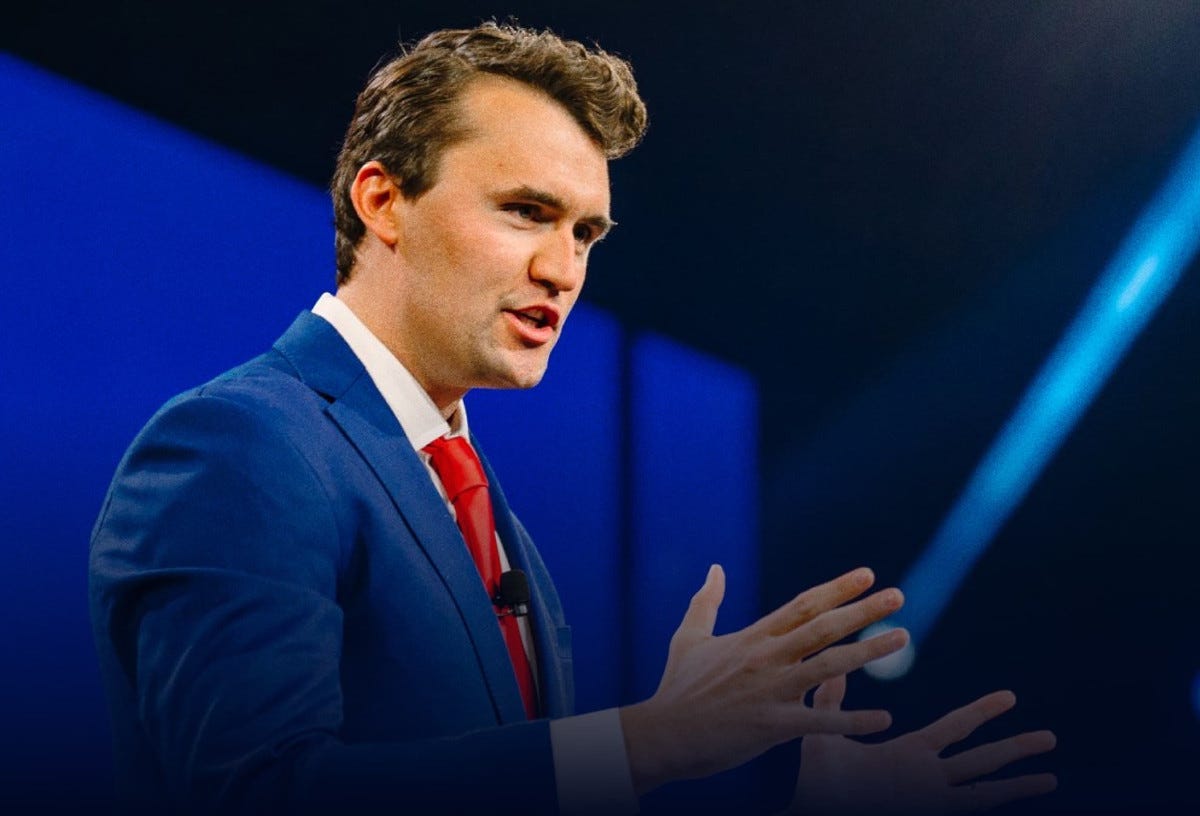
Kirk’s assassination tops list of news developments related to religion in 2025
Also, U.S. gets its first pope, and court cases tackle church-state fights over education
A political assassination. A first for an American Catholic. A U.S. Supreme Court that continued its friendly attitude toward religion in public schools. Antisemitism approaches the political mainstream. All these were among the religion-related news developments that drew attention in the United States during 2025.
In general news, 2025 was the year of Donald Trump; there was hardly a day that went by that news about him wasn’t the top focus of news media, both the mainstream press and partisan news sources on both the right and the left. And the same can be said to some extent about religion news: Of the top 10 news developments chosen somewhat arbitrarily here, at least half of them had some connection the president, even if was only a subject that he felt compelled to comment on.
In the previous two years, this site has chosen Trump’s continued popularity — despite what looks like a mismatch — with evangelical Christians as the top story of the year. But a shocking event on Sept. 10, the fatal shooting of religious-right activist Charlie Kirk while he was speaking to a crowd of students at Utah Valley University, dominated headlines in secular media for well over a week and has continued to have an influence on the nation’s religious psyche.
Here is a quick look at some of the top newsworthy developments in American religion during the past year:
1. Political activist Charlie Kirk becomes a religious martyr
Charlie Kirk was a relative unknown when he was fatally shot in Orem, Utah, but that changed in little more than an instant when gory footage of blood gushing from his neck quickly circulated in social media. In the time shortly after the shooting, The New York Times reported getting more web traffic than it did after President Trump was grazed by a bullet. Kirk’s life story as conservative activist who lured college students into impromptu debates became well-known and — as would be expected in 2025 — instantly polarizing. While conservatives praised him as a leading champion of free speech, especially on college campus, liberals circulated clips of him making racist and misogynistic remarks.
What I found most surprising is how quickly Kirk, known best for his political activism, became seen as a Christian martyr. There were unverifiable reports of significant boosts in church attendance the Sunday after Kirk was shot, and his memorial service a week after that seemed more like a Pentecostal-style evangelical worship service than a homage to the fallen.
And as it turns out, whatever boost Kirk’s style of evangelicalism received at first, something about it seemed to last. A survey by the Barna Group found that a fourth of American adults said they had taken some sort of spiritual action as a result of Kirk’s death.
2. Trump’s hold on American evangelicals appears to hold firm
Although there were signs at year’s end of cracks in Trump’s coalition, those cracks did not appear to extend to Trump’s evangelical Christian base. In fact, MAGA-backing evangelicals appeared to be the most stable part of Trump’s base, a loyalty that he reinforced through anti-transgender rhetoric and repeated claims of Christians being persecuted in the United States and abroad.
The pro-Trump enthusiasm has continued despite Trump’s making near mockery of a key Christian teaching while speaking at Kirk’s memorial service. Speaking after Kirk’s widow, Erika, had said she has forgiven her late husband’s killer, Trump defiantly told the crowd: “He [Kirk] did not hate his opponents. He wanted the best for them. That’s where I disagreed with Charlie. I hate my opponents and I don’t want the best for them. I’m sorry. I am sorry, Erika.” Despite his prideful disregard for the Golden Rule, Trump was warmly applauded.
3. Vatican selects first American pope
Argentina native Pope Francis died April 23 at the age of 88. On May 8, Chicago native Robert Prevost was elected to fill the top position in Roman Catholicism, becoming the first pope from the United States and adopting the name of Leo XIV. (He also is a citizen of Peru, where he had been a bishop.) Pope Leo has been generally viewed as a centrist, one who advocates for world peace and is in accord with traditional Catholic views on issues such as homosexuality. He also has been sharply critical of Trump’s immigration policies, denouncing them as inhumane.
4. U.S. strikes Nigerian site, ostensibly over persecution of Christians
Evangelical activists have long raised concerns about Nigeria, claiming that it is one of the worst countries for the persecution of Christians. The activists accomplished one of their major goals in early November when the Trump administration formally designated Nigeria as a Country of Particular Concern, setting the stage for what came next: a Christmas Day missile attack on a site in northwestern Nigeria that the Trump administration claimed was controlled by the Islamic State and tied to persecution of Christians. Future plans for military action are publicly unclear, and it appeared that the administration was oversimplifying a situation that involves plenty of violence not tied to persecution of Christians.
5. Supreme Court comes close to approving taxpayer-funded parochial schools
By the closest of margins, a 4-4 tie, the U.S. Supreme Court avoided approving one of the most radical expansions of government funding for religious education possible. Its tie vote had the effect of allowing a lower court’s rejection of a religious charter school run by Catholic dioceses in Oklahoma to stand. But the constitutional issue is likely to resurface soon as efforts are underway to create two other religious charter schools — a Jewish school in Oklahoma and an evangelical Christian school in Tennessee.
Meanwhile, in the most closely watched case involving religious rights, the top court sided with parents who on religious grounds had wanted opt their children out classes where books described as “LGBTQ-inclusive” would be read.
6. Two more states pass laws to post Ten Commandments in public schools
The U.S. Supreme Court in 1980 struck down a law in Kentucky that required the Ten Commandments to be posted in public-school classrooms, but that didn’t stop Texas and Arkansas from passing laws this year to do just that, following the lead of Louisiana, which passed such a law in 2024. So far federal courts have struck down the laws in all three states, but appeals to the Supreme Court are expected.
7. Perceptions of antisemitism draw criticism from both right and left
Political leaders and activists from both ends of the political spectrum made accusations that those on the other side were guilty of antisemitism. Two examples: Early in the year, the Trump administration send letters to dozens of colleges and universities threatening enforcement action over alleged antisemitism, most of it related to purported discrimination and pro-Palestinian protests. And later in the year, Democrats pointed to the rising acceptance of characters such as right-wing podcaster Nick Fuentes, known for, among other things, praising Hitler.
In December, an apparent terrorist attack linked to the Islamic State killed 15 people at a Hanukkah celebration at Bondi Beach, Australia.
8. Young males reported to become more religious
There were numerous reports during the year of a cultural shift toward young men becoming more religious, but it is unclear to what extent that is happening. What is fairly clear, at least according to the Pew Research Center, is that among young adults, men are about as equally religious as women — a change from older generations, where women tended to be more religious than men. But according to Pew, the change is coming about not so much because of a resurgence in religious interest among men but because of women becoming less religious. Only time will tell the extent of gender-related change in generational attitudes toward faith.
9. Transsexuality becomes major political concern among evangelicals
Transsexuality appeared to surpass abortion as the top culture war issue of concern to evangelicals, partly because of the way the Trump administration has elevated the issue while all but ignoring the fight over abortion. A Trump executive order has declared that there are only two sexes that are recognized by the federal government, which has moved against recognition of transsexuals by states and in federally funded programs. The U.S. military has also begun purging transsexuals from service. Meanwhile, evangelical activists have, with some success in red states, pushed for legislation related to gender-affirming health care, education policies and bathroom access.
10. Potential for abuses leads to religious concerns over artificial intelligence
Recognizing the potential for artificial intelligence to support human flourishing as well as the possibility for AI to be misused, religious leaders and academics met at the Vatican in October to sign a statement on AI ethics, advocating the principles of accuracy, transparency, privacy, security and human dignity/common good. Among the participants were representatives of Catholic universities, the National Association of Evangelicals, various Jewish organizations and The Church of Jesus Christ of Latter-day Saints.
Meanwhile, music written and performed by artificial intelligence rose to the top of Billboard Christian music charts, sparking controversy within the world of contemporary Christian music.


