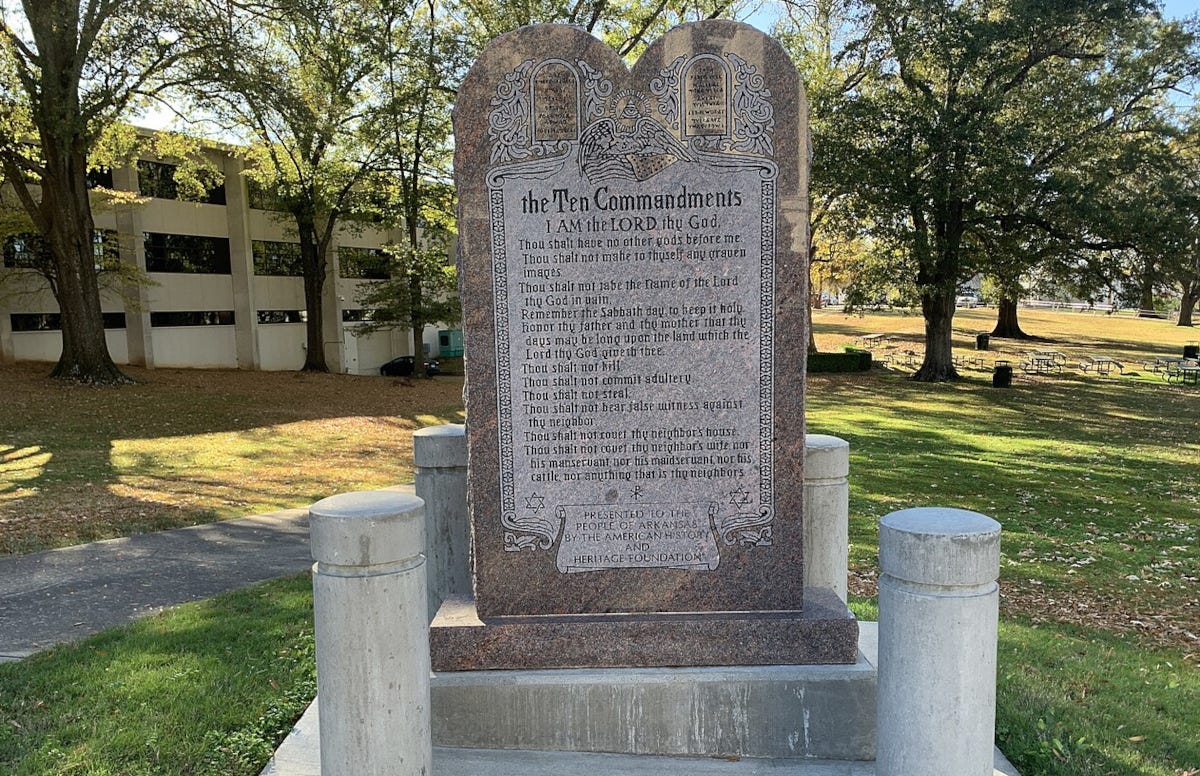
Judge rejects placing of Ten Commandments monument on Arkansas Capitol grounds
She determined that sculpture was intended to show preference for Christianity

More than a decade after the Arkansas Legislature first passed a law authorizing the establishing a Ten Commandments monument on the Arkansas Capitol grounds, a federal court judge has found the display of the three-ton sculpture unconstitutional.
In her ruling last week, Judge Kristine Baker of the U.S. District Court of the Central Division of the Eastern District of Arkansas invalidated the law authorizing the monument and ordered it to be removed. The part of her order involving the removal does not go in effect until either any appeals of her ruling are resolved or the deadline for filing an appeal has passed.
The monument has a convoluted history: The Legislature first passed the law authorizing a Ten Commandments monument in 2015, claiming that the Commandments “are an important component of the moral foundation of the laws and legal system of the United States of America and of the State of Arkansas.” The Satanic Temple then sought permission to install a monument of the pagan deity Baphomet, resulting in a 2017 law that set up a process for approval of monuments on state lands near the Capitol, a process that rejected the Satanists’ plan.
A Ten Commandments monument was installed in 2017, but it was almost immediately destroyed by a vandal using an automobile. A new monument, the one that was the subject of the lawsuit, was put up in 2018, this time protected by four concrete bollards.
In ruling against the monument, Baker found:
🟪 That the “primary purpose” of the 2017 law was to promote the Ten Commandments.
🟪 That “historical tradition or practice does not support” the law, a finding that was used in part to distinguish the case from Van Orden V. Perry, a 5-4 Supreme Court decision from 2005 that allowed a very similar Ten Commandments monument in Texas to remain on display.
🟪 That the law favored Christianity and deprived the Satanist group from promoting its beliefs on an equal footing.
🟪 That a discriminatory intent was a motivating factor behind the law.
Baker was appointed to her post by President Barack Obama.
As would be expected, Baker’s ruling received both praise and acclaim.
Among those happy with the ruling was Amitai Heller, the legal director of the American Humanist Association, which, among other things, promotes church-state separation. He said on his group’s website:
State capitols should be welcoming to all citizens, and this ruling rightfully rejects this effort to promote one specific set of religious beliefs above all others — including the right to not believe at all. This decision affirms the First Amendment’s bedrock constitutional principle of church-state separation, which ensures these very freedoms.
Meanwhile, Jason Rapert, a former state senator who had sponsored the monument legislation, condemned the ruling in a video on Facebook, saying:
The judge, Kristine Baker, has released this decision on the eighth anniversary [of the monument’s placement] ..., which I think is very, very interesting that she released a decision against the Ten Commandments during Holy Week, which is really just a slap in the face of Jews and Christians. ... This is Mosaic law. This is literally as much a Jewish symbol as a Christian symbol to some people.
Rapert promised that Baker’s ruling would be appealed.

