

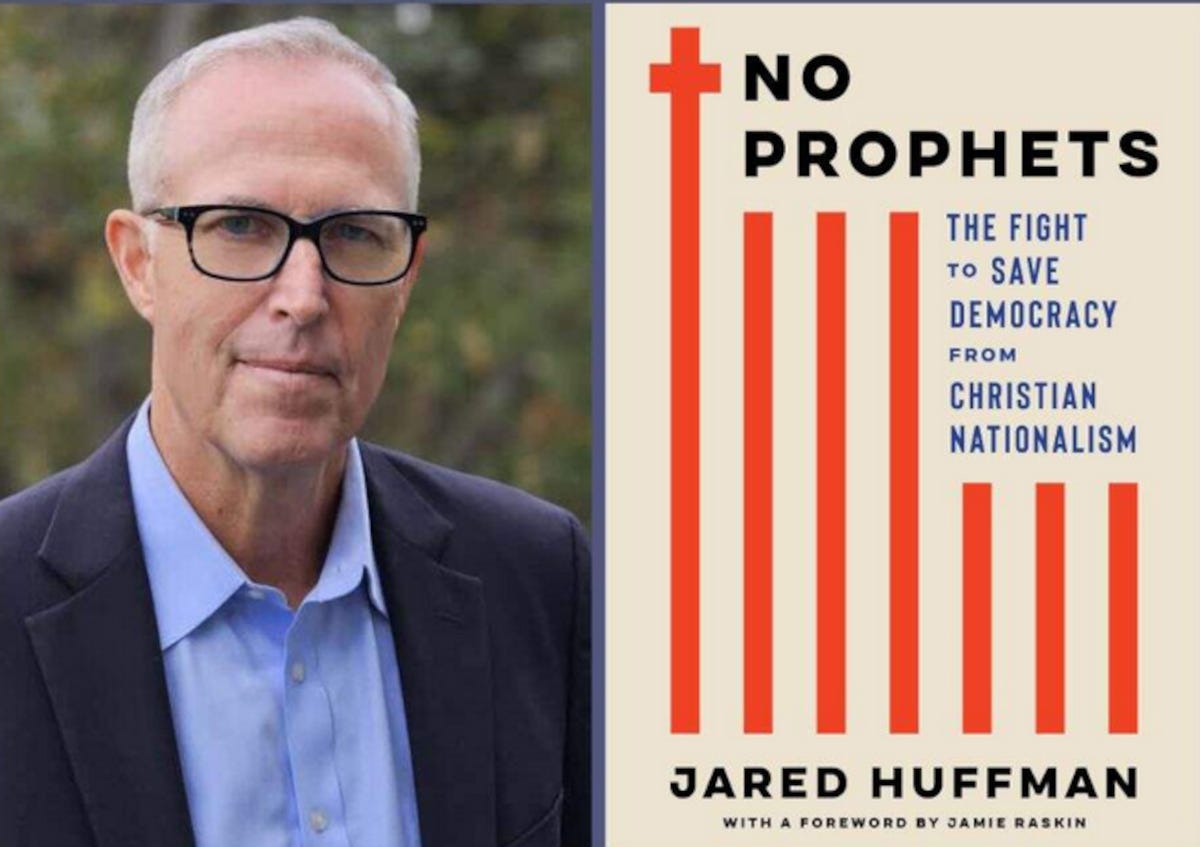
If you’re looking for evidence that Christian nationalism poses an existential threat to American democracy, you need not look beyond recent history. So says U.S. Rep. Jared Huffman in his just-published book, No Prophets: The Fight to Save Democracy from Christian Nationalism, which he opens with an account of his memories from Jan. 6, 2021.
He was hoping it to be routine day for a member of Congress, or at least as routine as a day could be when the main item on the agenda was certifying the results of a presidential election. He did know there was the possibility of a day that wouldn’t be routine, since he couldn’t ignore a gathering of Donald Trump supporters whose “rhetoric was luring and violence: extreme even by Trumpian standards,” a gathering akin to a megachurch revival meeting where “the religion dial was cranked to eleven.” And while he says most members of Congress didn’t notice or care about the role religion played in the event, his interest was more than piqued because of his interest in religious matters. He had grown up a devout Christian but left the faith as a young adult, he writes, publicly identifying himself in 2017 as a Humanist1, making him the only member of Congress, then and now, to publicly acknowledge that he doesn’t believe in God.
As Huffman saw it, those behind the insurrection of Jan. 6 weren’t so much involved in a political movement as the term is usually used as but in a religious crusade. He introduces the book’s thesis like this:
No Prophets argues that extreme Christian nationalism is now America’s most dangerous political movement. Its theocratic, authoritarian ringleaders, once dismissed as fringe, now wield mainstream power, and they’ve using it to dismantle secular democracy from within. From a frontline perspective, I’ll show how this threat has advanced much further than most people realize. Indeed, it will be hard at this point to stop it from turning America into something unthinkable for most of us — something our Enlightenment-era founders fought against and built Constitutional walls to protect us from. But I wouldn’t write this book if the fight wasn’t still winnable.
For me, the most interesting part of Huffman’s book, the part that offered me the most new information, was his account of how the Congressional committee that prepared a report on the Jan. 6 insurrection intentionally left out all but a tiny, passing mention of the role that Christian nationalism2 played in the event. He writes that “scrubbing Christian nationalism wasn’t just a lapse in candor an courage; it was a major security blunder that left our country more vulnerable to what has now become America’s most dangerous political movement.”
And Huffman places the blame directly on what he calls the stubborn insistence of Liz Cheney, vice chair of the House Select Committee on the January 6 Attack. He says that Cheney knew the committee’s report would have credibility only with her support, and she feared that if blame was placed on Christian nationalism that would detract from Trump’s culpability for the event. She feared that a focus on Christian nationalism also would alienate millions of Christians, and that the report as well as Cheney’s reputation might be perceived as anti-Christian.
Although not new to me, what also may be interesting to many readers is how the bulk of extreme Christian nationalism is made up of three distinct factions — and they don’t all agree with each other, neither theologically nor politically:
🟪 The New Apostolic Reformation, a largely decentralized movement of charismatic or Pentecostal churches3 that place an emphasis on spiritual warfare, miracles and prophetic visions. Leaders in the movement include self-declared prophets. As a prelude to the Second Coming, the movement advocates for Christians to take control of the “seven mountains” of cultural influence: religion, family, education, media, arts and entertainment, business, and government. Opponents to their efforts are often seen as demonic in nature. This is the largest faction of extreme Christian nationalism.
🟪 The Reconstructionist movement exemplified by the Communion of Reformed Evangelical Churches, sometimes known as the Theo Bros, founded by Idaho pastor Doug Wilson. The movement advocates for Biblical literalism, strict patriarchal authority and nationalist identity as the cornerstones for a Christian takeover of government. Ultimately, as Reconstructionists see it, church and state will become one to herald in the Second Coming. This is the version of Christianity that Secretary of Defense Pete Hegseth is affiliated with.
🟪 The Rad Trads, what Huffman calls the barely organized movement of Catholic traditionalist extremists who have been around since at least the 1920s and have opposed modernization of the Catholic Church while also supporting political causes such as anti-communism. Huffman sees Rad Trad influence on the Supreme Court as well as in some extremist influencers such as political commentator Nick Fuentes.
The power of these groups and their threat to democracy can’t be underestimated. Fortunately, Huffman offers hope to accompany his analysis. Much of that hope comes from those Christians, including evangelicals, who don’t agree with the agenda of the nationalists, and much of it comes from the growing number of “nones,” those without religious affiliation. Huffman describes a way forward for Christians and secularists such as himself to work together to support democracy despite the immense theological gap between them. Huffman’s book is the rare book capable of inspiring both the religious and nonreligious to pursue each others’ interests in creating a better future.
The capitalization is Huffman’s. He defines humanism as a belief system that “affirms our responsibility to lead meaningful, ethical lives based on compassion and rational inquiry without the inducement or fear of an afterlife.”
Huffman writes that experts define Christian nationalism “as the fusion of Christian religious and cultural identity with right-wing politics, rooted in a narrative of America as a ‘Christian nation.’” He believes that most American Christians reject the tenets of Christian nationalism.
These are distinct from traditional Pentecostal denominations such as the Assemblies of God and the Foursquare Church.