

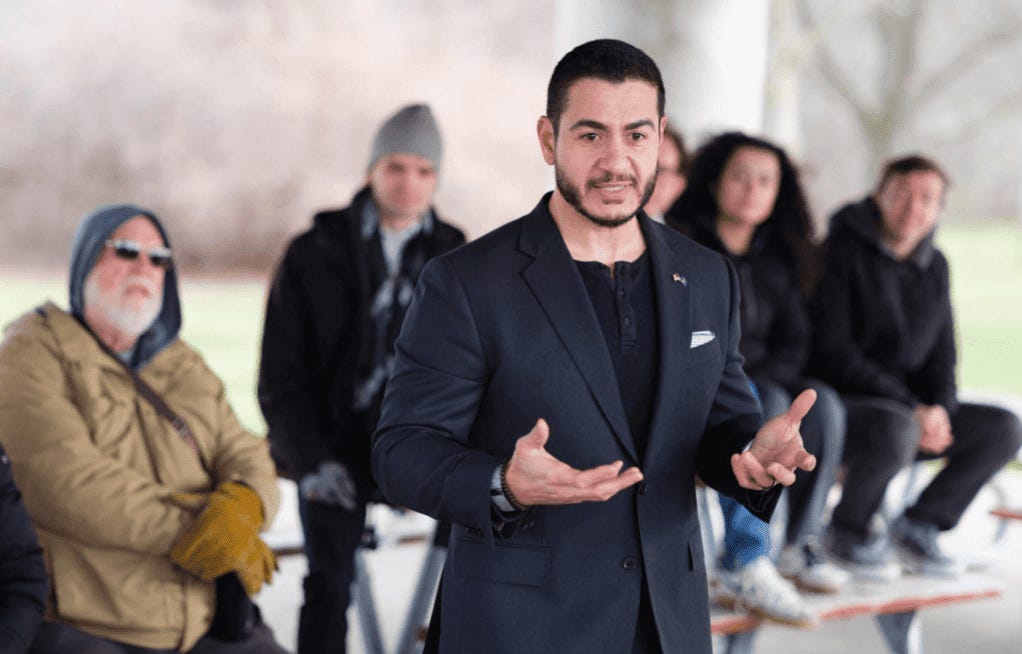
A Muslim has never served in the U.S. Senate, but that could change next year if Abdul El-Sayed has his way: The son of Egyptian immigrants, El-Sayed on Tuesday narrowly won the Democratic primary in Michigan’s U.S. Senate race, becoming the country’s first major-party Muslim nominee for the legislative body. He narrowly defeated U.S. Rep. Haley Stevens.
El-Sayed is expected to face an uphill challenge for the November contest: He’ll be running against Mike Rogers1, a Republican who is well known in Michigan politics. Rogers served seven terms in the U.S. House beginning in 2001 and ran as the Republican nominee for the U.S. Senate in 2024, losing to Elissa Slotkin by less than half a percentage point. And pundits say that Al-Sayed’s progressive politics — he was endorsed by U.S. Sen. Bernie Sanders and U.S. Rep. Alexandria Ocasio-Cortez — could make it difficult for him to attract centrist or nonpartisan voters. Supporters of Stevens during the primary had argued that she would be more electable than El-Sayed, but Stevens and her leading supporters united around El-Sayed once it became clear that he won the race.
It is a guessing game for now to predict how much of a role El-Sayed’s religion or ethnicity will play in the race. It may be that a statement on the homepage of Rogers’ campaign website that he “led the House Intelligence Committee to hunt down terrorists and keep Americans safe” is a not-so-subtle attempt to portray El-Sayed as soft on terrorism, although that statement has been prominent on the website since long before El-Sayed secured the nomination.
Four Muslims currently are in Congress as members of the House: André Carson of Indiana’s 7th District, Ilhan Omar of Minnesota’s 5th District, Lateefah Simon of California’s 12th District and Rashida Tlaib of Michigan’s 12th District. Carson is a mainstream Democrat, while the other three are identified with the progressive (or democratic socialist) wing of the Democratic Party. All four are expected to win re-election.
These days, the best-known Muslim in U.S. public office is New York City Mayor Zohran Mamdani, who last year became the first Muslim elected to that position. So Muslims elected to high office in the United States end to be aligned with political progressivism.
That Michigan could become the first state to put a Muslim in the Senate shouldn’t be surprising: Rakwa, a leading Arab-American news site, has called Michigan the epicenter of Muslim America, noting that about 3 percent of the state’s population is Muslim, the highest Muslim concentration the country. That’s more than twice the number for the nation as a whole. Michigan is home to the country’s largest mosque, and the city of Dearborn, Mich., has been called the Muslim capital of America. Rakwa said that Islam has played a major role in the state became of historical waves of Arab immigrants coming to work in the automobile industry beginning in the early 20th century2.
El-Sayed, a 41-year-old epidemiologist, has not previously held elective office. But he has been a public official, serving as director of the Detroit Health Department and later as director of the Wayne County Department of Health, Human and Veterans Services. He has been active in Michigan Democratic politics, running for governor in 2018, running a distant second in the primary to Gretchen Whitmer, who became governor.
According to the Religion News Service, El-Sayed has not been shy about discussing his faith. He told the RNS last year:
I believe deeply in the role that faith has played in my life, in, you know, how it orients me to try and be a better person, to give more of myself, to know my fellow creation, to treat people — all people — with dignity and humanity and respect.
El-Sayed’s candidacy has raised concerns among Jews and evangelical Christians who support the Israeli government. He has accused Israel of committing genocide in Gaza and has said more generally, according to The New York Times, that he doesn’t “believe in ethno-states.” A political action committee backed by a pro-Israel lobbying organization, the American Israel Public Affairs Committee, spent millions trying to defeat Al-Sayed in the primary. It is unknown to what extent AIPAC will get involved in the November contest.
Three minor-party candidates also are running: Douglas Marsh of the Green Party, Lydia Christensen of the Libertarian Party and Timothy Long of the U.S. Taxpayers Party.
Other states with major concentrations of Muslims are New York, California, Texas and Illinois.