

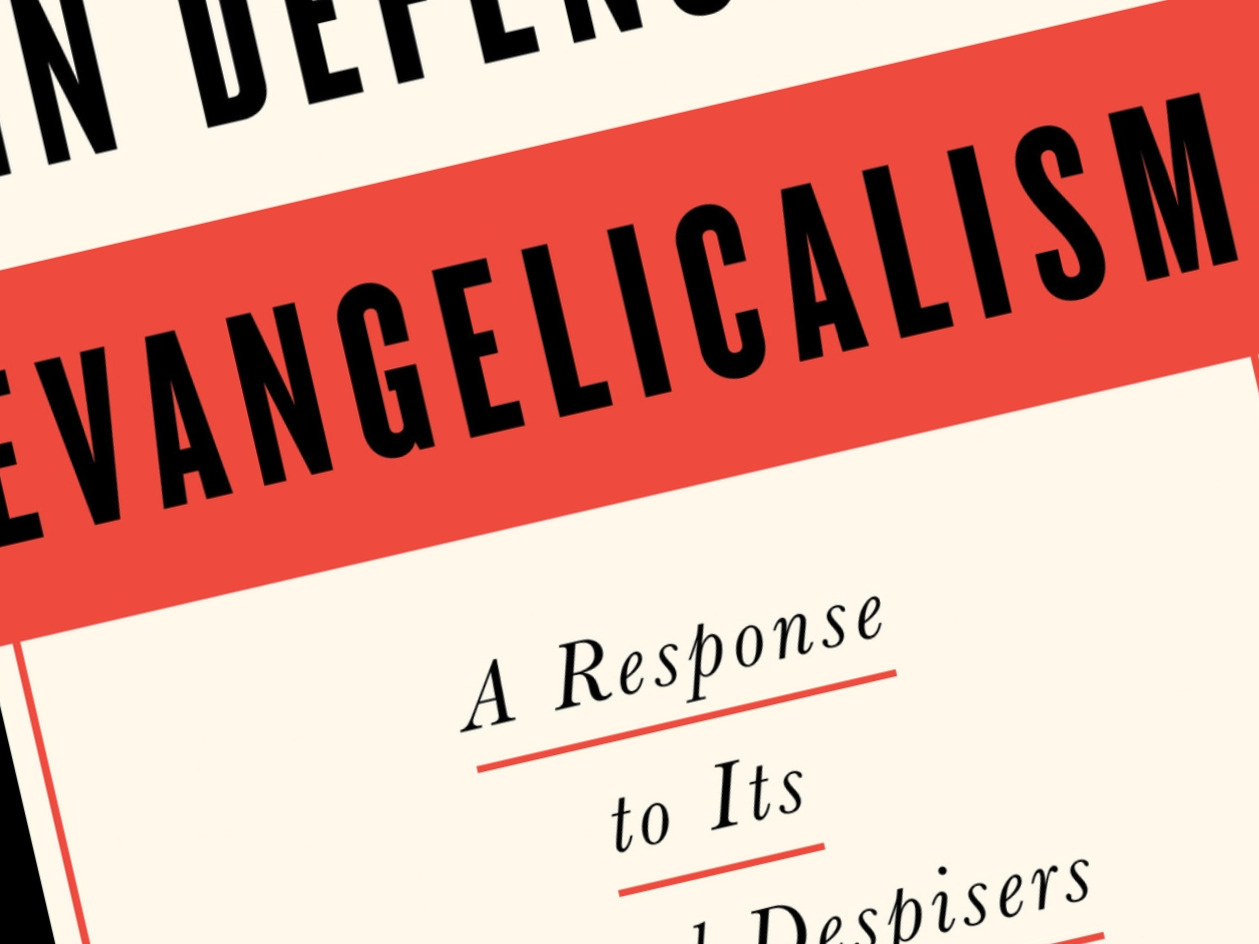
By trade, Bonnie Kristian is a writer and editor, currently employed a deputy editor at Christianity Today, easily the most journalistically credible publication written within the framework of American evangelicalism. But in her role as author of the just-released In Defense of Evangelicalism: A Response to Its Cultured Despisers, she plays the role of a skilled defense attorney in the court of public opinion with evangelicalism itself on trial.
As such an “attorney,” she offers the “jury” a point-by-point rebuttal of the points made by journalists, academics and others who for at least the past dozen years have made the case that evangelicalism is irrelevant at best, broken or harmful at worst. Kristian knows being persuasive will be uphill battle, for surveys have found evangelism to be a religion with one of the highest disapproval ratings in the country. Of course, this negative image is inextricably linked to Christian nationalism and the rise of Donald Trump and MAGA-ism.
Kristian — and it must be stated from the outset that she is a devoted evangelical who has been critical of Trump and his political movement from the beginning — organizes her book and argument into rebuttals of five beliefs or positions common among critics of evangelicals. Those positions are:
🟪 Evangelicals are more about cultural and political identity than they are about religious beliefs.
🟪 Even to the extent that evangelicals are about religious beliefs, those religious beliefs are harmful.
🟪 Even to the extent that evangelicals’ beliefs are positive, they don’t behave in the way they supposedly believe. In other words, they are hypocrites.
🟪 Like all Americans, evangelicals free to hold whatever religious beliefs they want. But they shouldn’t bring what should be private religious beliefs into the public, secular square.
🟪 Evangelicals are dominated by Christian nationalists, who by definition want to turn the United States into a church-run state that would, among other things, take away rights from people with religious beliefs that aren’t evangelicalism.
Kristian has sound, well-reasoned rebuttals against all those positions, but before she addresses them she struggles with what may be the most important question of the book: What is an evangelical? As she attempts to answer the question, it’s clear that there isn’t an answer everyone will agree on, no checklist that can be indisputably designed to separate evangelical Christians from other types of Christians. And simply determining how many people define themselves as evangelicals doesn’t help: A surprising number of people, even some Jews, Hindus, atheists and others who have no connection with evangelicalism as traditionally understood1, identify themselves as evangelicals in recent surveys.
Kristian ends up with this partial definition:
Evangelicalism isn’t an institution or organization but a movement, a tradition, a manner of worshiping Christ. It’s a culture of enthusiasm, a way of life shaped around intimacy with God. It’s the maintenance of a deep sense of personal responsibility to the truth and to the world. It’s the branch of Christianity that never tires of repeating that Jesus died for you. As the kids say, it’s a vibe.
And as a vibe, evangelicalism has no central office or official creed. There’s no pope, no membership rubric for who’s in and who’s out. The reality is that evangelism has some fuzzy boundaries.
In the end, that’s about the most of a definition that Kristian can give, except to add that evangelism as she uses the term necessarily refers to Christians. Explicitly trying to avoid the “no true Scotsman” fallacy, Kristian says it makes more sense to talk about those who are more or less evangelical rather han saying that some on the edges aren’t evangelical at all. An example of someone she sees as less evangelical is Doug Wilson, an Idaho pastor who has been described as a spiritual mentor to Secretary of Defense Pete Hegseth and who would bring an end to woman’s suffrage. As Kristian puts it: “Wilson would have to be included in American evangelicalism by any is or isn’t measure. But if we think about more or less, Wilson is undeniably less. ... Historian George Marsden famously quipped that ‘an evangelical is someone who likes Billy Graham.’ No one would define an evangelical as someone who likes Doug Wilson.’”
This struggle with defining exactly what evangelicalism is — a struggle that is far from unique to Kristian — ends up being the biggest weakness of her book, for she often claims that the worst of evangelicalism comes from its fringes or is otherwise atypical of evangelicalism as a whole. The rebuttals she makes to the anti-evangelical positions — such as the reality that individual evangelicals tend to be charitable and evangelical worship services nearly always focus on matters of salvation rather than on politics — are sound, but it seems there are always exceptions.
To her credit, Kristian doesn’t absolve evangelicalism of its shortcomings. In fact, in some ways, there are times that she verges on being as critical of certain aspects of evangelicalism as its detractors are. And she explicitly argues against the belief that some evangelicals have that they are being persecuted for their faith.
A book evangelicals will cheer
I suspect that most traditional evangelicals, both those who voted for Trump and those who can’t stomach him, who read this book would be willing to give it a five-star rating, appreciating the way how Kristian sees the good in evangelicalism that isn’t always seen in mainstream media or a wide array of cultural influencers.
But I can’t be quite so enthusiastic about the book, even though I recommend it. And that isn’t because I find my self in sharp disagreement with most of her arguments. I agree with her that some of the worst problems with evangelicals come from the fringes of evangelical belief and culture. I agree with her that evangelicals are often held to a higher standard than are adherents of other faiths. I agree with her that most evangelicals seek to love their neighbors. I agree with her that evangelicals have made great strides in overcoming prejudice within their ranks. There really is much positive that can be said about evangelicals!
But somehow, the sum total of Kristian’s arguments aren’t enough. I still see a religious movement whose most influential leaders have been complicit, maybe worse, in the U.S. government’s policies of cruelty toward immigrants and others that the Christian faith has referred to as “the least of these.” I see some of the politicians most complicit in that trend — I’ll use U.S. House Speaker Mike Johnson as an example — as coming from mainstream evangelicalism, not its wacko fringe. I fail to see many of evangelicalism’s most prominent leaders (although there are exceptions) pushing back against cultural coarseness with any of the fervor that they used when such coarseness could be blamed on Hollywood or Democrats. The prophets of the Bible, particularly those of the pre-Christian era, had a reputation for challenging authority, but I don’t hear much of that kind of prophetic voice today in evangelicalism.2
Maybe I’m unfairly faulting Kristian here for trying to do the impossible. Maybe she is like the attorney trying to defend an obviously guilty client — somebody has to do it.
All that said, I can’t help but agree with some of Kristian’s final words. Writing to evangelicals, she says:
We must live up to the evangelical name, and any credible criticism will point us to the same reform. Be more serious. More studious of Scripture. More often in church. More faithful in prayer and diligent in service and capable of clear-eyed explanation for why we act and believe as we do. Be more evangelical, not less.
Amen.
Modern evangelicalism as traditionally understood can be traced to the modernist-fundamentalist controversy that dominated debate among U.S. Protestant theologians and leaders in the early 20th century. To simplify considerably, on one side were the fundamentalists who were concerned about doctrinal purity and argued that the Bible is inerrant and should generally be understood literally, and on the other side were the modernists who had a more flexible view of the Bible and were willing to reconcile their interpretation with scientific understandings and their desire for social reforms. The fundamentalists eventually became a key part of the evangelical movement that included Southern Baptists and a wide array of smaller Protestant denominations, while the modernists came to dominate what we now call mainline Protestantism. Evangelicalism has always been a movement rather than an organization; its best-known leader at the end of the 20th century was evangelist Billy Graham.
I do hear that kind of prophetic voice coming from Pope Leo.