

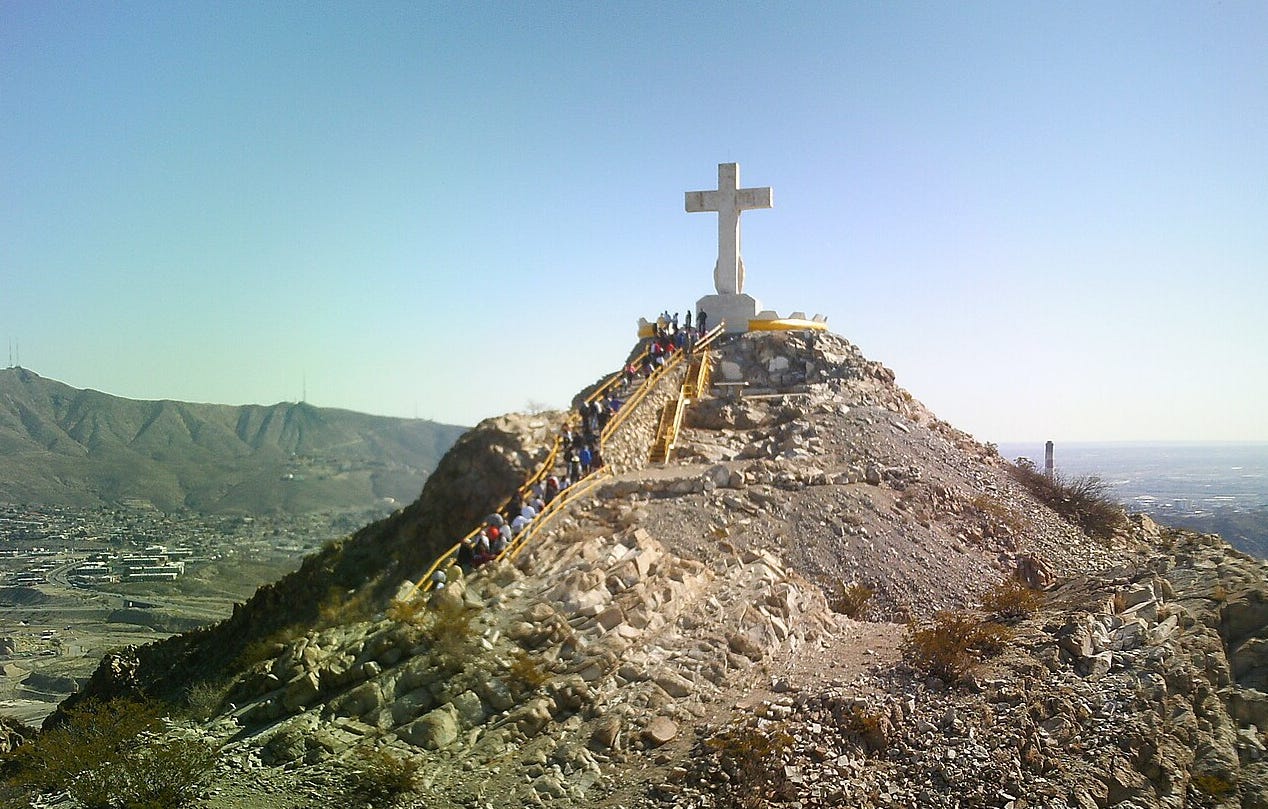

Calling a proposed section of the U.S.-Mexico border wall “offensive to Catholic values and teachings,” a Catholic diocese has gone to court to block the Trump administration from using its power of eminent domain to build the section on diocese-owned property near a popular shrine that features a statue of Jesus overlooking Sunland Park, N.M.
The diocese claims in court papers filed Friday that the proposed property seizure violates both the First Amendment, which provides for freedom of religion, and the federal Religious Freedom Restoration Act, which was written to expand religious protections beyond those provided by the Constitution.
The Roman Catholic diocese says in the papers that construction of the border wall there “would profane this holy site” and “deprive the Diocese of its ability to act as a steward of the land.” The diocese also calls the plans “an affront to religious liberty.”
The diocese filed the papers in response to a decision by U.S. District Court of New Mexico Judge Kenneth J. Gonzales, who ruled June 15 that the U.S. Department of Justice could deposit $183,071 into a bank account as compensation for property it intends to seize. The amount is based on the presumed fair-market value of the land, as is normal in eminent domain cases. Although the proposed section of border wall would not close the shrine or block the route to it, there is disagreement between the Trump administration and the diocese about whether the fence would interfere with the experience of the tens of thousands of pilgrims who visit the site each year.
The case is United States of America v. 14.259 Acres of Land.
Gonzales, a Barack Obama appointee, made his ruling on technical grounds involving the Declaration of Taking Act, which regulates the procedures for federal seizure of property for government use. Gonzales said that his ruling is not a final decision on the property’s disposition, that the federal government doesn’t get immediate possession, and that the diocese still has the right to seek judicial relief. Gonzales did not address the religious-freedom concerns that the diocese has raised.
The 29-foot-tall monument portraying Jesus atop the 4,675-foot mountain was completed in 1939 by sculptor Urbici Soler, world-famous at the time. The hike pilgrims take to the top of the mountain is 5-mile round trip. Some pilgrims crawl on their knees to the site as a sign of devotion. As many as 40,000 people in one day have been reported to visit the site on religious festival days.
The Department of Justice has been trying to obtain the site for at least several months, hoping to fill in a gap in the border wall, a gap that has been often used for illegal crossings. The legal fight is new, however, as the government first filed documents May 7 to start the seizure process.
In contesting the judge’s ruling, the diocese disputed claims by the federal government that the visitors to the site would not be affected:
The Government insists in conclusory fashion that its proposed course of conduct “will not impact the Diocese’s access or use of Mount Cristo Rey” and that the mountaintop shrine “will be accessible in the same manner as it had been prior to the taking.” ... There are several reasons to doubt the Government’s representations. First, former Secretary of Homeland Security Kristi Noem waived compliance with a host of statutes and regulations that safeguard culturally, historically, and environmentally sensitive sites in connection with border-wall construction. ... The Government therefore did not undertake the careful review that ordinarily would accompany a federal construction project of this sort. Without such a review, the harms that the Government’s actions will inflict on the mountaintop shrine, access to the same, and the natural landscape that inspired its creation in the first place are simply unknowable. Accordingly, there is no reason for this Court to credit the Government’s barebones assurances regarding the impact of wall construction on the shrine or access paths.1
The diocese also said that the federal government “has shown little respect for Mount Cristo Rey” during the preparatory work it has done so far in the area. The diocese pointed in particular to a federal promotional video that said the mountain “will undergo a face lift” even though “the only face on Mount Cristo Rey is that of Christ the King.”
The federal government has yet to file a response to the diocese’s papers. A court hearing has been tentatively scheduled for July 23, according to news reports.
Ellipses are used in this excerpt solely to indicate the omission of legal citations.