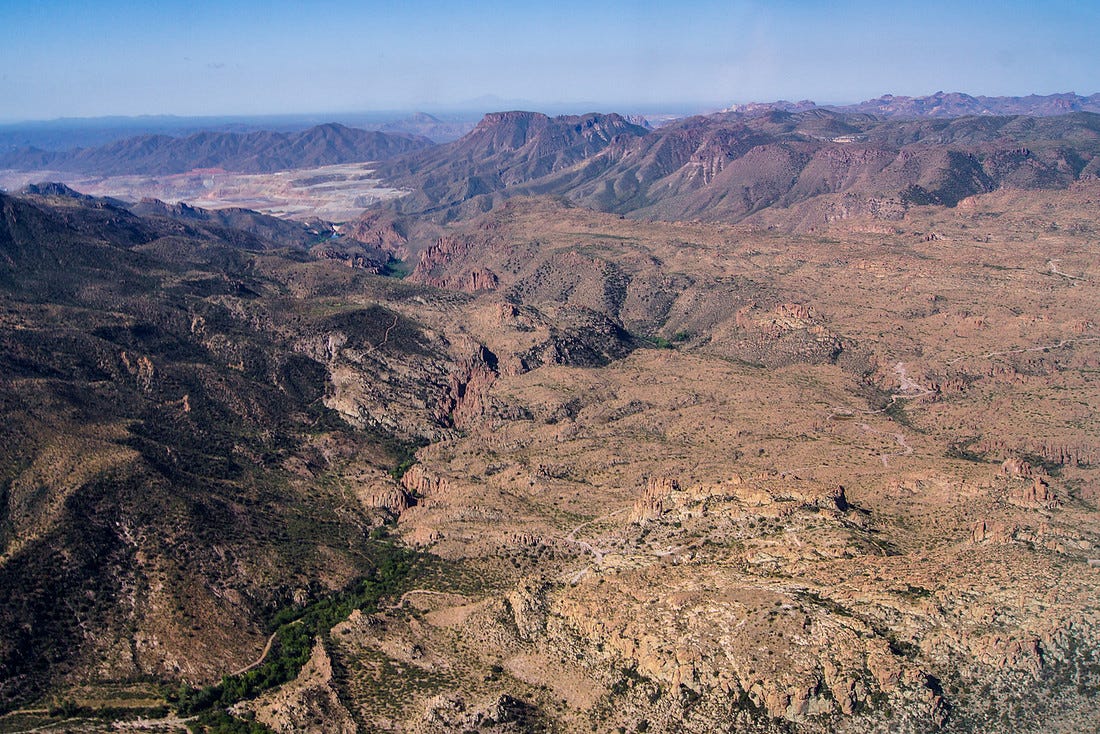
Despite last year’s Supreme Court setback, Native tribes continue fight over sacred lands
Tribes claim they have constitutional and treaty rights to use planned mining site

When the Supreme Court nearly a year ago refused to hear the appeal of a coalition of Indian tribes over plans to dig a huge open-pit copper mine at Oak Flat, Ariz., it looked like legal hopes for the tribes had been vanquished.
But that appears no longer to be the case.
The tribes, united for litigation purposes as the Apache Stronghold, claim that indigenous peoples have been using the site since time immemorial for “prayer, gathering medicine, and holding religious ceremonies.” As they note, they have been using the land since long before the land had become Spanish territory or part of the United States.
Indian use of the land is threatened by Resolution Copper’s plans for a multibillion-dollar project that would destroy the surface of the region in order to mine copper and other minerals more than a mile below the surface. The federal government is involved because the site has been owned by the federal government, which had approved a land swap to allow for the mining construction.
The Apache Stronghold — whose legal supporters have included a coalition of Christians, Sikhs, Jews and other religious adherents and the one of the nation’s leading law firms, Becket, involved in religious-freedom litigation — first filed suit to stop the project in 2021. The dispute has had a complicated legal history that includes lawsuits by other organizations, has been litigated as far as the Ninth U.S. Circuit Court of Appeals, which ruled 6-5 in 2024 against Apache Stronghold, saying that the planned land swap would not deny Native Americans an “equal share of the rights, benefits, and privileges enjoyed by other citizens.”
The tribes claimed that the land swap violates, among other things, the federal Religious Freedom Restoration Act. They also claim that they have treaty rights to continue using the land for worship. According to the Becket law firm, Oak Flat is listed in the National Register of Historic Places and was formally protected from mining and other harmful practices for 70 years until a controversial last-minute provision was slipped into a must-pass defense bill in December 2014.
The tribes also claim that the project would violate environmental laws and the National Historic Preservation Act.
The Ninth Circuit ruling was immediately appealed to the Supreme Court, which last year refused to hear the case. As is typical, the Supreme Court did not state why it decided not to hear the case, nor how many of the four justices needed to sign on to hear a case had done so. But in an unusual move, Justice Neil Gorsuch, joined by a colleague, Clarence Thomas, wrote a dissent saying that the high court had made a “grievous mistake” in refusing to consider the appeal. “Faced with the government’s plan to destroy an ancient site of tribal worship, we owe the Apaches no less,” Gorsuch wrote.
What has changed since that Supreme Court rejection is that land was formally transferred to Resolution Copper in March — in a way that an amended version of the Apache Stronghold v. United States lawsuit says is illegal.
“The feds rushed the Oak Flat transfer through under cover of darkness because they wanted to dodge meaningful judicial review,” Becket senior counsel said in press statement. “That was as illegal as it was brazen. The court should rescind the illegal transfer and protect the freedom of Western Apaches to continue worshiping at Oak Flat for generations to come.”
The federal government has yet to formally responded to the amended lawsuit.

