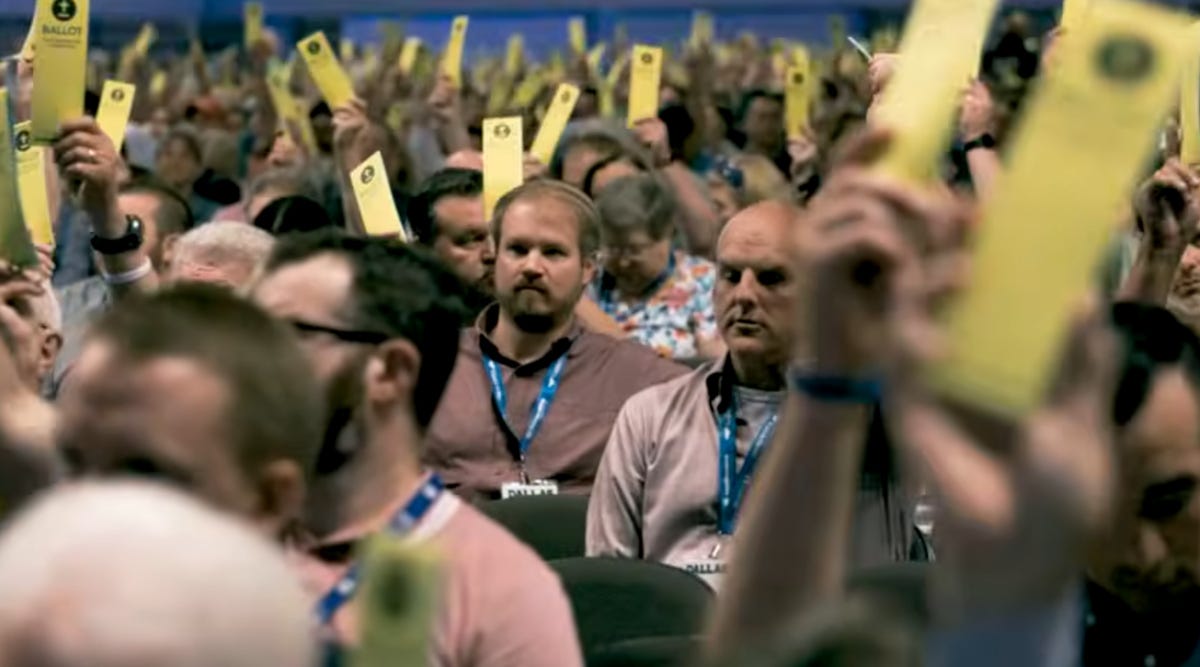
Delegates to annual Baptist meeting expected to debate women’s church roles, immigration
Other concerns on agenda include antisemitism, civility in public discourse

An expected 20,000 Southern Baptists are gathering in Orlando, Fla., for their annual meeting this week — and there is likely to be no shortage of controversy.
The Southern Baptist Convention, an association of more than 40,000 churches made up of some 12 million members, is the second-largest Christian denomination in the United States, behind the Catholic Church, and the largest Protestant one. Although the churches are autonomously run, they annually send delegates, known as messengers, to a convention that sets denominational policies and organizes or supports programs such as seminaries and missionary outreach.
It has become almost a tradition that the convention discusses and votes on controversial issues, which in recent years have focused matters of women’s church roles and sexual abuse scandals as well as political matters. Such concerns are coming up again this year as messengers face a flurry of resolutions ranging from the routine (expressing appreciation to the host city) to the national issues of the day such as antisemitism and political violence.
The resolution that likely will have the most influence on how churches operate if it is adopted is one designed to clarify where the SBC stands on women’s roles in the church. As with many other conservative Protestant denominations, Southern Baptists maintain that men and women are of equal worth in the eyes of God but that only men are authorized to authorized to hold roles that the New Testament refers to as pastor, bishop, elder or overseer. Even so, some SBC churches have had women serve in various pastoral roles, ones not including the head pastor of a church, that the churches claim are permitted by the New Testament.
The proposed resolution would “encourage Southern Baptist churches to maintain clarity and integrity in their ministerial titles and practices so that nomenclature is not used in ways that obscure or contradict the Convention’s adopted statement of faith regarding the pastoral office; specifically, we encourage churches to use the titles ‘pastor,’ ‘elder,’ and ‘overseer’ in a manner consistent with the biblical office described in Scripture and affirmed in The Baptist Faith and Message 2000 and not to use these titles in ways that separate the title from the office and function of pastor.”
Politics at the forefront
Of the 11 resolutions scheduled to be voted on, five are related to today’s political issues. The resolution drawing the most attention is one on immigration. It attempts to thread the political needle, calling for compassion for immigrants while also calling for “lawful immigration enforcement carried out justly” and rejecting “amnesty, understood as forgiveness of legal violations without accountability.”
Specifically, the proposed resolution calls on Southern Baptists to “reject racism, nativism, ethnic supremacy, and dehumanizing rhetoric, affirming that Scripture alone defines our identity, worth, and unity in Christ and that no person bearing the image of God should be reduced to a slur, statistic, or political problem.”
But it also notes that “[l]arge-scale and often disorderly migration has strained communities, harmed migrants and American citizens, and diminished confidence in the rule of law, underscoring the need for immigration systems marked by order, clarity, due process, timely adjudication, integrity in asylum processes, fairness, and humane enforcement.”
Other politically oriented resolutions facing the messengers would:
🟪 Affirm Southern Baptist support for religious liberty and call on Southern Baptists “to pursue national renewal through biblically informed civic engagement, including advocating for just laws that are rooted in God’s natural law and consistent with the witness of holy Scripture, and electing public officials who will do the same.” The resolution also calls the United States’ 250th anniversary a “historic milestone to remember and reflect upon God’s providential blessings.”
🟪 Call on governments “to resist efforts to legalize or expand assisted suicide, and to promote policies that affirm the inherent dignity and worth of every person.”
🟪 Call for civility in public discourse, noting that “we reject hatred, malice, slander, dehumanization, intimidation, reckless speech, and contemptible conduct as inconsistent with Christian discipleship, while also rejecting a false peace that refuses necessary truth.”
🟪 Condemn a “new surge of antisemitism in all its forms, including violence, cultural hatred, and conspiracy theories of Jewish controlled cabals, as sinful, unchristian, and an assault on both biblical truth and basic human dignity.”
Church governance also at issue
Other proposed resolutions:
🟪 Express appreciation to the city of Orlando in hosting the convention.
🟪 Call on Southern Baptists to develop or expand plans for inclusion of persons with disabilities.
🟪 Express gratitude to pastors and ministry leaders who have “labored faithfully over many years and finished well, keeping the faith and maintaining a testimony above reproach to the end.”
🟪 Express “heartfelt gratitude to Southern Baptist bivocational and volunteer pastors for their faithful and sacrificial service to Christ and his church.”
🟪 Call for “the responsible use of digital technologies and platforms as aids to ministry, while recognizing that such tools cannot fulfill the biblical functions of the gathered church, cannot replace the personal ministry of pastors and members, and should be used to support and encourage connection to the embodied life of a faithful local church.”

