

Dallin Oaks, president of The Church of Jesus Christ of Latter-day Saints, was a member of the Utah Supreme Court for more than three years. But he’d rather see disputes over laws resolved in state legislatures and Congress rather than in the courts, he said yesterday in an address at the Washington National Cathedral.
One reason is because courts are limited to cases that come before them, often making it difficult to settle all aspects of an issue. A related reason is that legislative bodies can consider “the overarching, complex, and comprehensive policy-making that is required in a circumstance like some of the current conflicts between two great values” and thus can provide for negotiation among competing interests.
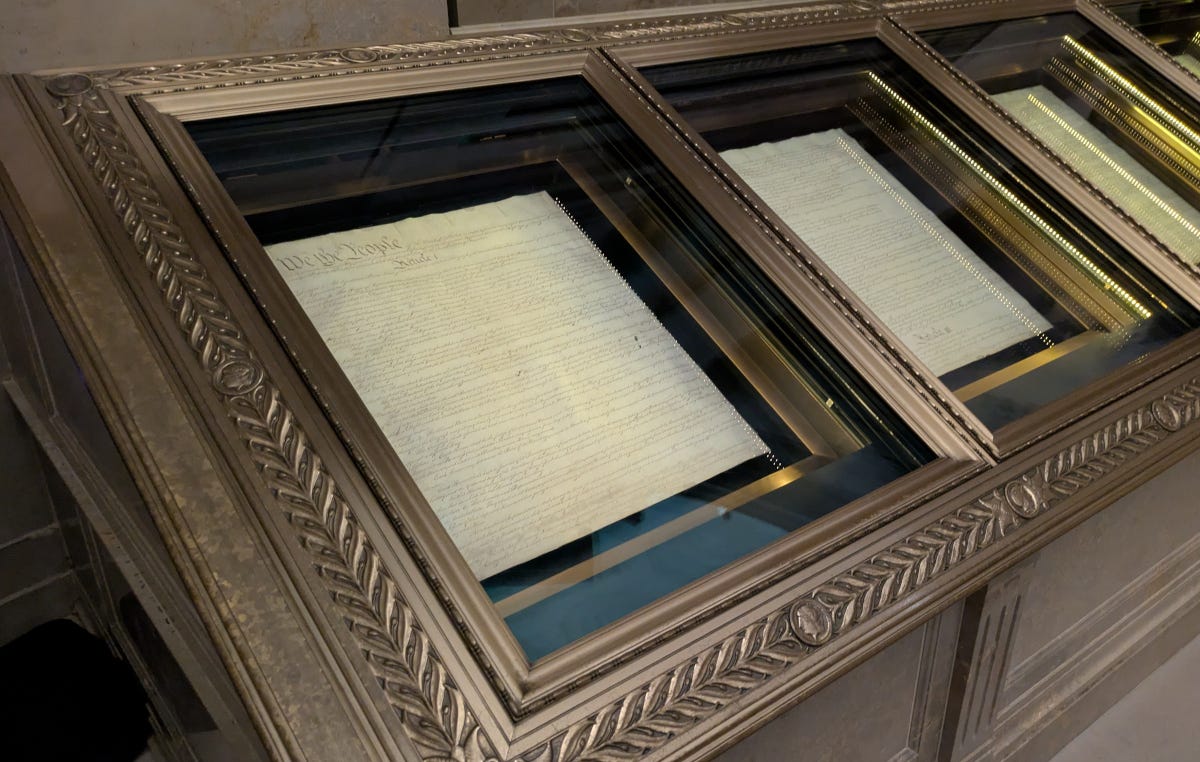
Oaks made what his church called “a landmark address on religious freedom” at an interfaith event sponsored by the cathedral on the eve of today’s Constitution Day, which marks the 229th anniversary of the Constitution’s signing. Oaks became president of the LDS church last year after the death of the then president, Russell Nelson. Previously, he had been an apostle in the denomination for 42 year after a law career that included an internship with the U.S. Supreme Court and a law professorship for 15 years. He has long been a student of the Constitution, which he said is inspired in the sense that it was based on divine principles, which to him include the separation of powers, the guarantees of individual rights, and the rule of law rather than by individuals. During his church tenure, he said, he has come to more fully appreciate the needs of people of faiths other than his own:
As a religious person who has served in government at both federal and state levels and now as leader of the worldwide Church of Jesus Christ of Latter-day Saints, I have always known of the tensions experienced when persons who rely on the free exercise of religion are conflicted between duties to God and duties to country. More recently, I have come to understand better the distress of other minorities who feel that some of us are invoking constitutional rights like free exercise of religion and freedom of speech to deny or challenge their own core beliefs and their basic constitutional rights.
Oaks did not specifically mention any current controversies nor current political leaders. But he did point to the “Utah Compromise” that made Utah (where the LDS church is the dominant religion) the first, and so far only, red state to outlaw employment and housing discrimination based on sexual orientation and sexual identity. He suggested that the approach taken could be a model for other legal controversies tied to religion:
The issue there was a Salt Lake City ordinance on housing and employment, first proposed in 2009. This was a head-to-head conflict between free exercise of religion and nondiscrimination. The Church of Jesus Christ of Latter-day Saints and nondiscrimination advocates — adversaries in that contest — reached out to each other and participated in negotiations. This was previously thought impossible. However, both sides learned to understand each other’s positions, including what they deemed most important to be protected by law. The two sides worked together with the Utah Legislature, which amended the Utah antidiscrimination act in 2015.
The outcome offered protections to both sides. One side obtained significant legal protection from discrimination in employment and housing. The other side gained protection for religious freedom in its most sensitive areas of church employment and student housing. While the law gave neither side all that it sought, its reconciliations did grant both sides significant benefits. This win-win outcome could not have been obtained without the balancing of interests made possible by the dynamics of a legislative process.
Oaks said that for there to be freedom and unity, all should be willing to recognize the importance of working for the common good, which means that no side will attain a full victory:
As a practical basis for unity, all of us should accept the reality that we are fellow citizens who need each other. This requires all of us to obey some laws we dislike and to live peacefully with some persons whose values differ from our own. We should make every effort to understand the experiences and concerns of others, especially when they differ from our own.
We should be especially careful not to seek total dominance for all our own positions. Even though the First Amendment obviously guarantees the right to exercise or practice religious beliefs, that vital right is not absolute. Advocates for absolute religious freedom should yield to the reality that in a nation with citizens of many different religious beliefs or disbeliefs, the government must sometimes limit the right of some to act upon some of their beliefs when it is necessary to protect the health, safety, and welfare of all.
Where there is genuine conflict on the effect of constitutional rights, contesting positions need to be balanced legally and negotiated politically in a way that upholds all essential rights to the greatest extent possible. We need to work for a better way forward — a way to resolve differences without compromising core values. We should seek fairness for all. This is not easy when we differ on what are fairly judged as fundamental rights in a pluralistic society. ...
Living together in peace requires goodwill among those who differ. The effort also requires time and patience to sort out what is truly non-negotiable for each major participant. The goals of both sides are best served by resolving differences through mutual respect, shared understanding, and good faith negotiations. And all participants must accept and respect the rule of law. [Emphasis in original]
Oaks said that such negotiation is in accord with the teachings of Jesus and St. Paul, who taught, respectively, that “blessed are the peacemakers” and that Christians should “follow after the things which make for peace.”1
Matthew 5:9 and Romans 14:9, respectively.