

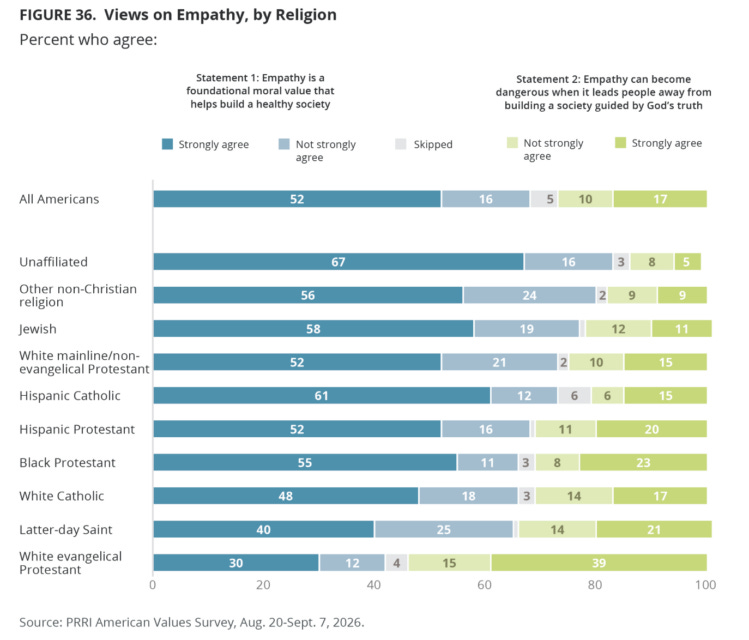
A survey released Tuesday by the Public Religion Research Institute found that among people without a religious affiliation, 67 percent strongly agreed with the statement “Empathy is a foundational moral value that helps build a healthy society,” and 83 percent agreed, whether strongly or not. But the agreement rate among all of the seven Christian groups whose responses were analyzed by PRRI was lower, in some cases much lower.
A majority of most Christian groups, led by Hispanic Catholics and white mainline Protestants or nonevangelical Protestants, still see empathy as a foundational value. But white evangelicals, the survey finds, are hostile to the idea. In fact, a higher percentage of white evangelicals find empathy to be dangerous than who agree it is a foundational value.
Precisely, among white evangelicals, a majority, 54 percent, agree with the statement “Empathy can become dangerous when it leads people away from building a society guided by God’s truth.” Most of those, 39 percent of the total sample, strongly agree.
The numbers come from an online survey of 5,539 U.S. adults conducted between late August and early September. (Of those, 5,200 were from a representative sample, with the remainder including 339 persons added to increase the sample size from small states.)
The survey’s findings show that popular evangelical influencers such as Joe Rigney and Allie Beth Stuckey are making inroads in persuading evangelicals that there are severe risks in loving their neighbors too much. Those influencers, including various pastors and others prominent in the religious right, claim that empathy can make people try to justify the sins of others.
Among that group, so much for the teachings of St. Paul, who urged fellow Christians to “rejoice with those who rejoice and weep with those who weep,1” using what is close to a dictionary definition of empathy.
The distrust of empathy also doesn’t seem evident in the Bible’s accounts of the life of Jesus. The Gospels tell us of a Jesus who was repeatedly moved with compassion, such as when he saw anxious crowds2 or when encountering those who were literally untouchable.3 And in parables such as that of the Good Samaritan4 he taught his follows to treat even outsiders with compassion.
A religious group showing mixed results in the survey was the Latter-day Saints, where about two-thirds see empathy as a foundational value. But more than any group other than white evangelicals, Latter-day Saints also see empathy as dangerous. More than a third, 35 percent, indicated that concern.
After those with no religious affiliation, Jews and adherents of other non-Christian religious showed the most appreciation of empathy. About 77 percent of Jews agreed that empathy is a foundational value, as did 80 percent of the other non-Christians.
Other parts of the survey showed a strong link between views on empathy and political perspective. Robert P. Jones, the president and CEO of PRRI, gave this analysis:
As Christian nationalist leaders attack the sentiment of empathy, a disturbing “empathy gap” has opened, separating Republicans and white evangelicals from most other Americans. Such orchestrated attacks are typical of violent authoritarian movements and should be disturbing to all who care about the moral foundations of our pluralistic democracy.
Romans 12:15.
See, for example, Matthew 9:36 and 14:14.
See Mark 1:41.
Luke 10:25.