Children’s Bible storybook breaks the mold by suggesting Bible doesn’t provide final answers
Book review: ‘God’s Stories as Told by God’s Children’ by multiple authors, presented by The Bible for Normal People, ★★★★☆
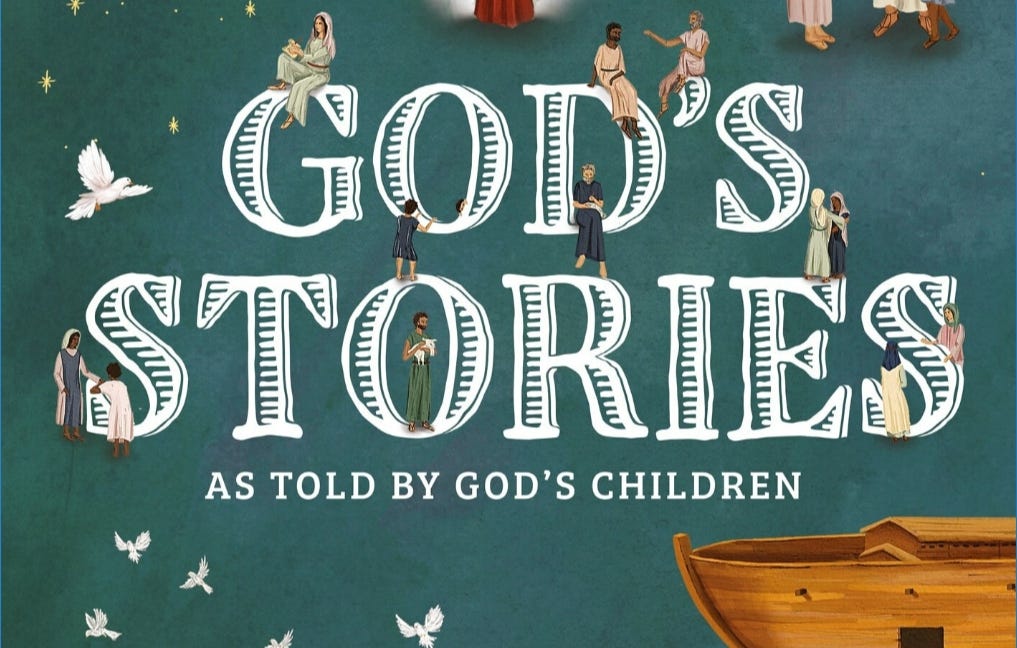
God’s Stories as Told by God’s Children is a children’s Bible storybook like no other.
It may not have even really been written for children, who may find much of it beyond their reading level and miss many of the points the writers are trying to make in the same way that children often do not understand double entendres present in some children’s movies.
First of all, an explanation of what God’s Stories is: It’s the first book-length production of The Bible for Normal People, an entity that would be called a ministry if it were run by evangelicals. Instead B4NP is a theologically diverse group, one with a largely deconstructing or progressive Christian audience, that is devoted to devoted to bringing Biblical scholarship to ordinary people. So the book is written not by the folks who typically write children’s books but by a diverse collection of 55 scholars, theologians and storytellers from around the world; most, but not all, identify as some kind of Christian, and they also come from a variety of countries, ethnicities and sexual identifications.
So if you’re looking for a Bible storybook from an evangelical perspective, much less a strict Calvinist one, this isn’t it. And if you’re looking for a storybook that treats the Bible as infallible or even internally consistent, you won’t find that here either.
And, actually, you won’t find much of a unifying theme either, with 55 authors and nine illustrators. If there is a dominant theme to be found with careful purview, it’s that God has a kingdom (or, as some authors say it, a kin-dom) that welcomes all.
What you will find is solid writing that’s also entertaining while respectful in a relaxed way of the source material. Fifty-some chapters retell Bible stories from the Creation to John’s Revelation of, as the author tells it, “God’s vision for peace, healing, love, joy, friendship, and beauty.”
Writing styles vary from author to author, but many attempt a breezy style. Some follow the original source material quite closely, while others take literary liberties, although only one goes the extreme that the author of the Proverbs retelling did, reframing the collection of sayings as a conversation of farm animals such as the pig with a gold ring in her snout, an image inspired by Proverbs 11:22.
Most of the stories include sidebars that provide historical, literary or theological background, such as explanations of what the Bible means by wisdom or what it meant to talk about the tribes of Israel. And QR codes with the stories direct readers to additional resources, some free and some with a cost.
God’s Children isn’t intended to get children to read the Bible as authoritative in the sense that what it says is incontrovertible. Here, for example, is how a sidebar reacts to the story of Abraham and Sarah:
One of the things you might notice as you read through the stories in the Bible is that things happen in them that are not okay. In fact, they are downright wrong.
Two of those things happen in this story. First, Hagar is enslaved by Sarai and Abram. And second, they use her body without her consent to grow their family. ...
These things are 100% wrong. It is never okay for one person to enslave another or for one person to use another person’s body without their consent. Ever.
But here is the weird thing: the Bible doesn’t actually say this. It would be nice if it did, but it doesn’t, and that is because the Bible’s stories reflect the world in which their storytellers lived.
If you’re comfortable with this approach to understanding the Bible, you’ll find this book useful in introducing your children — including your teenagers, who are likelier to understand it — to the Bible and its themes. And if you aren’t comfortable with that approach, you may well find a few portions offensive. It’s a book that openly invites discussion rather than providing the answers.
A note about the electronic edition
Although God’s Children is available in an edition for Amazon’s Kindle, it is much better suited for a print edition. The Kindle version is distributed in a pixel-by-pixel reproduction of the print edition, giving the typesetting a less than clean look, and the text isn’t searchable or able to be highlighted. And of course, the colorful illustrations do not reproduce well on a black-and-white screen. While the vibrant pages look attractive on a tablet, they are nearly unreadable on a phone-size screen. By all means, if you buy the book, get it in print.


