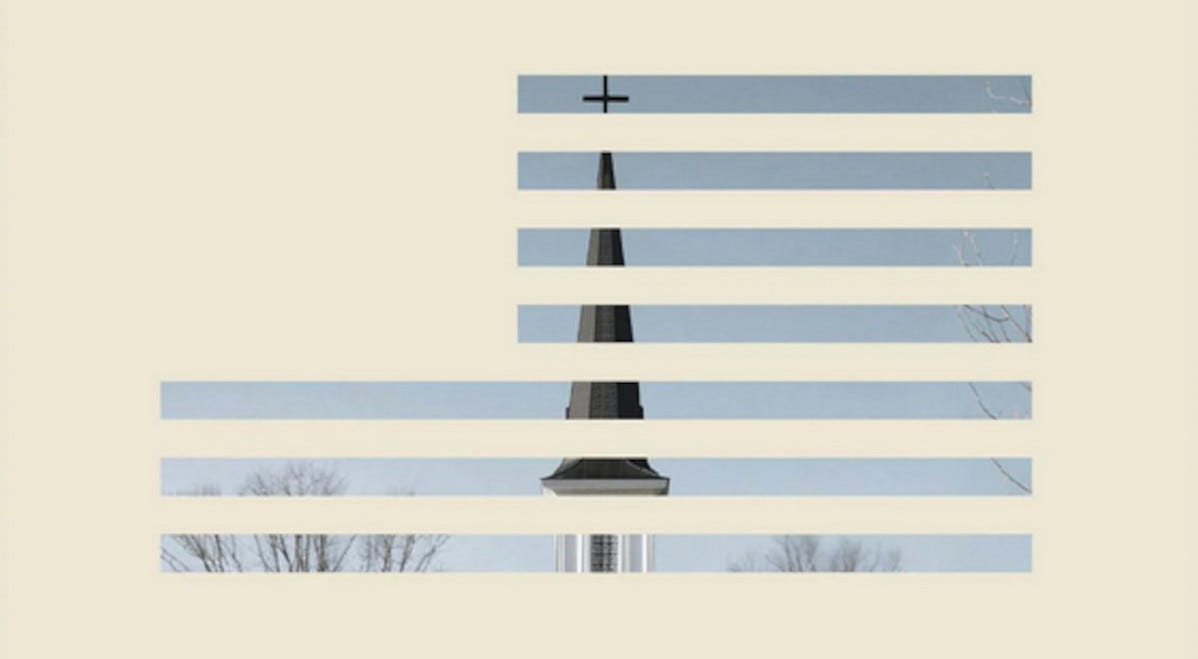
As American religious life trends rightward, author perceives loss of a stabilizing force
Book review: ‘The Vanishing Church: How the Hollowing Out of Moderate Congregations Is Hurting Democracy, Faith, and Us’ by Ryan P. Burge, ★★★★★
Not all that many years ago, to be an evangelical was to have certain theological beliefs, such as basing personal salvation on accepting Jesus Christ as savior and seeing the Christian Bible as an infallible source of eternal truth.
But the evangelicalism of, say, the 1970s and the 1980s is no more. These days, people who describe themselves evangelical may not even be Christians in the traditional sense of the word; they might even be Jewish or Muslim.
So says Ryan P. Burge, a data scientist and former American Baptist minister, in his newest book, The Vanishing Church: How the Hollowing Out of Moderate Congregations Is Hurting Democracy, Faith, and Us. In a little more than 200 data-filled pages, Burge demonstrates not only how religious identification has changed in the United States during the past half-century or so, but how that change is affecting American political and cultural life.
As Burge sees it, religious changes are at the heart of the polarization that is wreaking havoc on the American political system and dividing the country as well as families.
The increasing number of Americans who don’t identify themselves with a religious tradition has received plenty of attention in recent years, but Burge’s analysis goes far beyond that data point. It is not just the number of people who identify with a religion that has changed, but also the type of religion with which they identify. And the big change Burge sees over the decades is the decline of mainline Protestantism — think of Episcopalians as well as the largest Methodist and Presbyterian denominations, among others — which served as a moderating force in American lives, as churches provided a place where Republicans and Democrats, social conservatives and social liberals, could worship and socialize together.
In the late 1950s, one analysis indicates, more than half of all Americans were connected with the mainline Protestant churches. According to one authoritative survey, around 30 percent of Americans were mainline Protestants in the early 1970s. Today that number has fallen below 10 percent. He uses the example of the United Methodist Church, which had 11 million members in the late 1960s, about the same as the Southern Baptists, and had congregations in 95 percent of the country’s counties. Today, thanks in part to a schism that caused hundreds of conservative congregations to leave the denomination, United Methodists number less than 5 million.
Meanwhile, new priests in the Catholic Church became increasingly conservative, as did the evangelical denominations. The result is that the moderate mainline denominations have become increasingly irrelevant, and when Americans think of Christianity, they tend to think of a conservative rather than unifying religion.
Although he doesn’t know all the reasons why it happened, the changes in religious life accelerated during the 1990s in a trend Burge calls the “Big Church Sort,” and the trends from that decade continue today:
Among Christians (especially white Christians), the pull is unmistakably to the right. White evangelicalism has never been more politically unified than it is right now. ... While the mainline stands in the middle of the political spectrum, it continues its march toward irrelevance as its numbers and cultural power dwindle. ...
The two Christian groups that have managed to maintain a robust membership, Catholicism and evangelicalism, have done so by drifting to the right. That’s certainly made them a haven for cultural conservatives, but it has also tended to scare away people whose politics are further to the left. The mainline’s commitment to ideological diversity has left its denominations on the verge of collapse. ...
Instead of the American religious landscape looking like a normal distribution, with lots of folks clustered around the midpoint, it looks like two mountains, one on the left and one on the right, with a chasm in between.
Burge goes so far to say that evangelicalism itself has become a political identity: He points to a study showing that a significant people in a dozen religious groups — groups that include Christians, Buddhists, Hindus, Muslims and atheists — often identify as evangelicals if they are Republican:
The word “evangelical” has become a shorthand for people of all faith groups to say, “I am a political conservative.” It’s no longer primarily a theological belief in the death and resurrection of Jesus Christ. For a growing number of Americans, to be an evangelical is to vote for Republicans on Election Day.
Despite all the religious changes, Burge still sees the United States as a religious country: Most of those who never attend religious services still say they believe in God. And while he is concerned about religious and political polarization, Burge believes that typical Americans are moderate, sensible and pragmatic, even on contentious issues.
Burge’s book is more than an impressive collection of statistics; it’s also in part a personal journey for the author, who as a former pastor and current believer sees religious participation as a past stabilizing force and future hope for the United States. He closes his book with his ideas for a path forward, but it is worth noting that his proposed actions are sourced from personal conviction rather than institutional change. He says he is both hopeful and afraid, concluding that while he is “under no illusion that American religion is the greatest panacea for all that ails the United States, I am convinced that the American church can be part of the solution.” And he offers the data to show how that may be the case.


