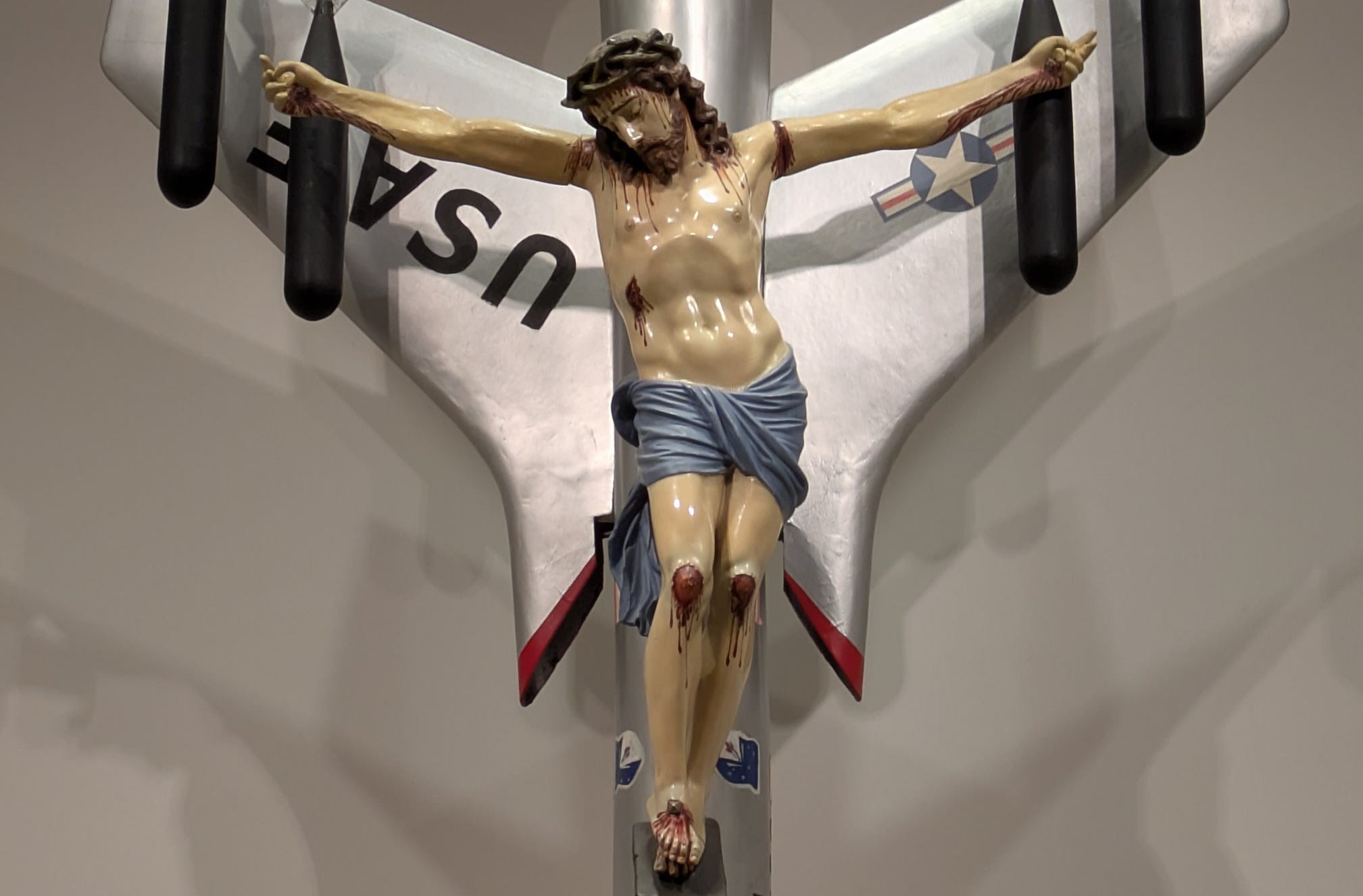
Artist’s reimagining of Crucifixion remains as shocking and timely as it was six decades ago
On display at Buenos Aires museum, sculpture continues to draw attention

Round one of the corners onto a ramp in the National Fine Arts Museum in Buenos Aires and you'll come up to a sculpture you can’t ignore: It's an approximately life-size painted plaster sculpture of a Santería depiction of the crucified Jesus, hanging not on a cross but on a wood sculpture of a U.S. military jet. It's a sculpture that is so shocking — even offensive — that the artist, León Ferrari, was pressured to withdraw it from an Argentinian art competition in which he had entered it in 1965.
But the withdrawal only served to draw more attention to Ferrari's other protest-themed art, and the artwork, titled Western and Christian Civilization in Spanish1, ended up being displayed far outside of Argentina and inspired a musical work called Unrelated Words. An adaptation of the sculpture even appeared on the cover of rock music album in 1973.
And judging from what I saw during my visit to the museum in January, the sculpture appears to attract far more photographers than any of the other hundreds of works in the landmark museum.
The sculpture’s provocative nature is of course one reason it continues to draw a wealth of attention from the museum’s visitors. But part of the the reason may also be similarities of the political climate when Ferrari created the sculpture and today’s.
Ferrari was an outspoken opponent of the Vietnam War and of U.S. President Lyndon Johnson in particular. Ferrari also was known for opposition to his own government, and at one point his work was criticized by Argentinian Catholic Cardinal Jorge Bergoglio, who later became known as Pope Francis.
As the title of his work suggests, Ferrari saw Western civilization along with Christianity as corrupt. The idea wasn't new to him in 1965; for years before then he had protested the Argentinian government, often using religious themes, including figures such as Jesus and Mary, that were sure to draw a severe reaction in largely Catholic Argentina.
Ferrari died in 2013, a few years before Donald Trump’s ascension to power. It is impossible to view his Civilization sculpture and not think that he would have seen the same corruption in the Trump administration, which has evangelical Christians as his largest constituency, as he did in the Argentina and United States of the 1960s. And linking Christianity (or a part of it) to Trump's military policy isn't far-fetched at all. It was lobbying by evangelical Christians that was the biggest impetus for a recent American attack in Nigeria, and outspokenly evangelical Christians such as Secretary of Defense Pete Hegseth have been among those who have shaped today’s military policies; Hegseth at times has explicitly linked his military goals to his Christian faith and has used Christian symbols in Pentagon events and media.
As I woke up Saturday morning to news of the American-Israeli attack on Iran, one of the first things that came to my mind was this sculpture. Such is the power of effective art, that it can convey meaning and evoke thought even when far removed from the environment in which it was created.
La civilización occidental y cristiana.

